Validator Consolidation: A Capital-Efficient Way to Migrate to stVaults
As Ethereum's validator entry queue stretches past 50 days, migrating existing stake into stVaults through the standard exit-and-redeposit path means leaving ETH idle – and leaving rewards on the table.
The Consolidation mechanism, introduced with Pectra (EIP-7251), offers a more capital-efficient alternative: transfer validator balances directly on the consensus layer, keeping most of your stake productive throughout the transition.
For operators and institutions moving into stVaults to access stETH liquidity and DeFi integrations, consolidation means you can start benefiting from stVault features without sacrificing weeks of rewards to get there.
Earning Rewards While Migrating
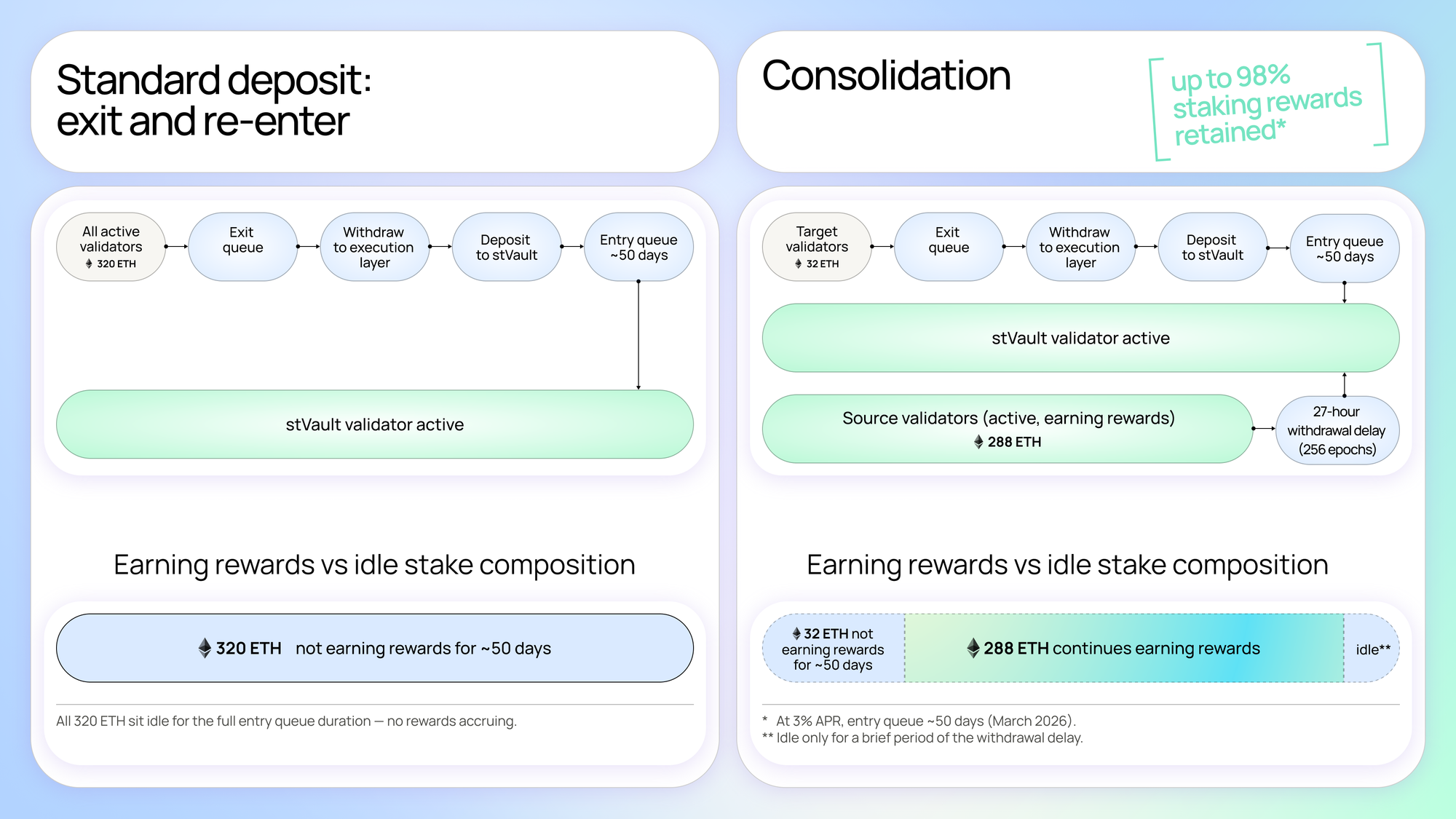
The standard migration path – exiting validators and re-depositing ETH into stVaults – puts all ETH through both the exit and entry queues. The longer the queues, the more rewards are missed on idle capital between the withdrawal sweep cycle and the validator entry queues.
Consolidations enable operators to transfer a validator balance directly between validators (from source to target validators) on the consensus layer, without withdrawing and re-entering the deposit queue later.

How Consolidations Work
- Start activation of the target validator(s) in the stVault. Deposit the minimum required amount of ETH to create one or more target 0x02 validators (32 ETH per validator). The required ETH can come from exiting an existing validator or from other liquid ETH. Each validator now can hold up to 2,048 ETH of effective balance, so the number of targets depends on the total stake being migrated. This minimum required deposit enters the standard entry queue.
- Continue earning on active (source) validators. While the stVault validator(s) wait for activation, existing validators keep operating and earning rewards as usual.
- Consolidate once the targets are active. Transfer the remaining validators' effective balance into the stVault validator(s) directly on the consensus layer, bypassing the entry queue entirely.
After consolidation is initiated, source validators continue earning rewards until their exit epoch. The stake is idle for just the ~27-hour withdrawal delay (256 epochs), after which the balance transfers to the target and begins earning again.
Only the initial deposit sits idle during the long entry queue. The rest of the stake keeps earning rewards while waiting for consolidation.
Validator Consolidations In Practice
Under EIP-7251, a single validator can hold up to 2,048 ETH of effective balance. For operations above that threshold, multiple target validators are needed. The formula is straightforward: total ETH ÷ 2,048, rounded up.
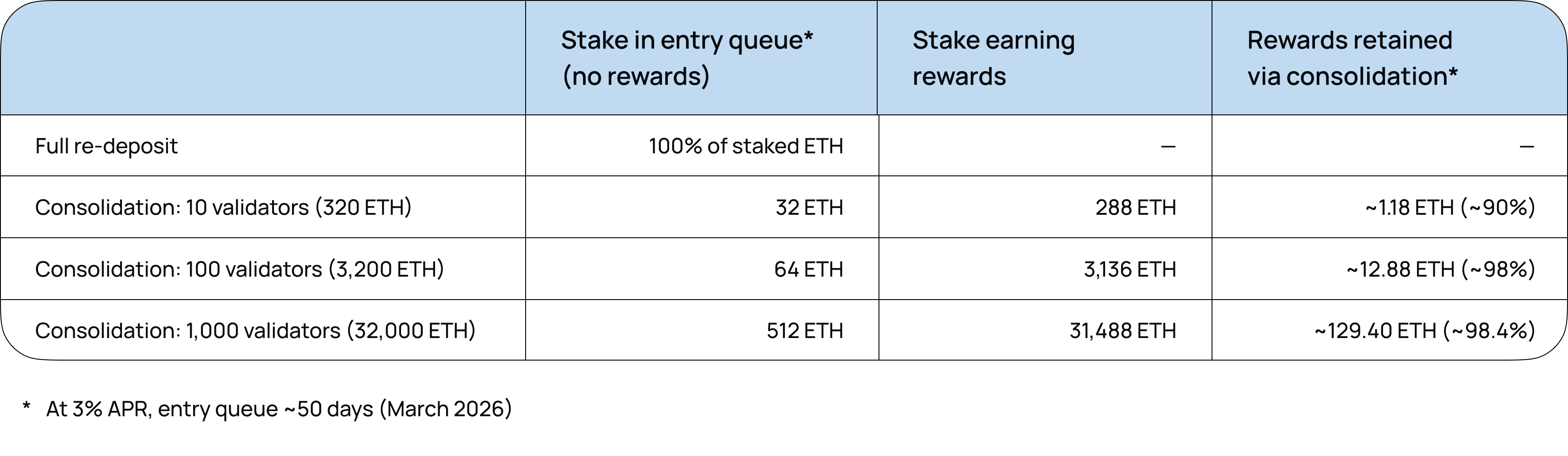
Consider an operator with 10 validators (320 ETH). They exit one validator, withdraw 32 ETH, and deposit it to create a single stVault target validator. While that target waits in the entry queue (~50 days), the remaining nine validators (288 ETH) continue earning rewards.
Once the target activates, consolidation is initiated — source validators keep earning until their exit epoch, and the only idle period is the ~27-hour withdrawal delay before the balance lands on the target. The result is one stVault validator with a 320 ETH effective balance, with only 32 ETH idle during the long wait.
The same approach scales:
An operator with 100 validators (3,200 ETH) would exit two validators, deposit 64 ETH to create two stVault targets (both enter the queue simultaneously — one wait period, not two), and consolidate the remaining 98 validators across them once active. The 3,136 ETH keeps earning throughout the ~50-day wait, with only 64 ETH in the waiting line. The end state: two stVault validators at 1,600 ETH each — preserving roughly 12 ETH in rewards compared to withdrawing and re-depositing everything.
Requirement & Limitations
Consolidation has specific conditions and trade-offs. Source validators must have been active for at least 256 epochs. Operators with active validators and standard withdrawal credentials can use them as consolidation sources. Full requirements, limitations, and a step-by-step guide are available on Lido Docs.
Next Steps
The full technical guide is available in the stVaults consolidation documentation.
- Learn more about stVaults and start building
- Join V3 builder group in Telegram