Recap: Lido Tokenholder Update: February 2026
The Poolside Tokenholder Update call on February 26 covered 2025 full-year results, the current financial outlook amid shifting market conditions, and Q2 focus areas.
The session was led by Vasiliy Shapovalov, Executive Director at the Lido Labs Foundation; Isidoros Passadis, Chief of Staking at the Lido Ecosystem Foundation; and Kate Zueva, Deputy Chief Operating Officer of Lido Labs Foundation.
Below is a recap of the key topics discussed. For the full conversation, watch the recording.
Key Takeaways
- Despite market pressure, January and February closed operating positively. Lido Foundations' leadership is responding to current market conditions with cost discipline, maintaining a focus on long-term treasury surplus and financial control until the market stabilizes.
- 2025 spend was ~10% lower YoY, reflecting active market adaptation (ETH outflows, APR compression, and shifting staking demand across the sector).
- 2025 delivered major releases across staking, decentralization, governance, and institutional expansion — CSMv2, Lido V3, Dual Governance, WisdomTree ETP, and an expanded node operator set.
- Q4–Q1 results: stVaults rollout, Lido Earn reached 61K ETH TVL, WisdomTree ETP launched (~$36M AUM), DAO take rate increased from 4.96% to 6.11%, and custodian and ETF integrations are underway.
- Q2 2026 focus: expected to expand the staking ecosystem with stVaults and ETPs, release MetaVaults (EarnETH / EarnUSD), and deploy automated buybacks.
Agenda
- Financials and market conditions
- 2025 year wrap-up
- Automated buybacks
- Lido market state
- Q2 2026 focus
Financials
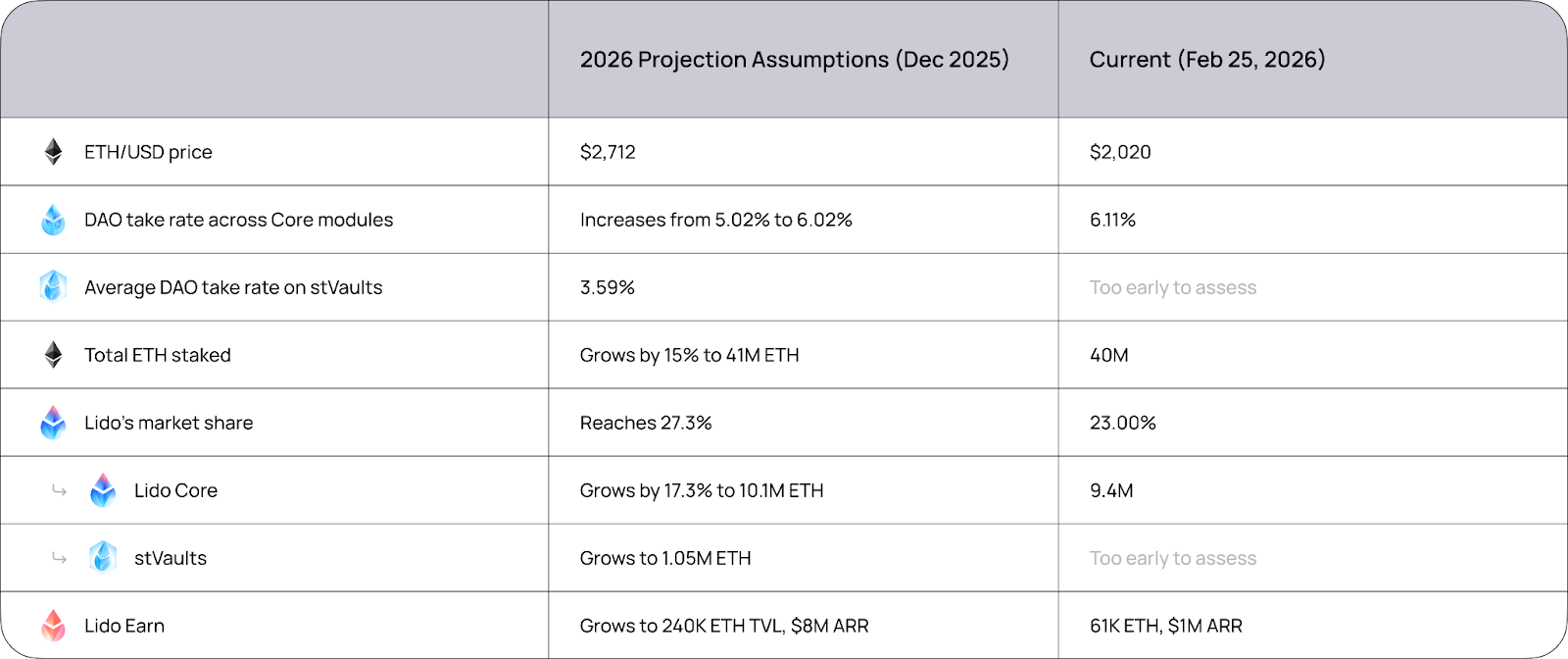
The 2026 EGG grant request was based on a projected average ETH price of $2,712 — a cautious assumption at the time, with ETH trading above $3,000 in late December. ETH has since dropped to $2,020 as of February 25, putting pressure on the original DAO revenue projections.
2026 Assumptions vs. Current State
Impact
At ~$2,000 ETH, projected net revenue from staking fees (including stVaults) drops from $45.3M to $33.4M, and total revenue from $53.9M to $40.6M.
If all originally planned spending were maintained, the projected treasury gap would be approximately $20.5M. In practice, leadership is holding the line on spending, and February actuals are closing with a surplus.
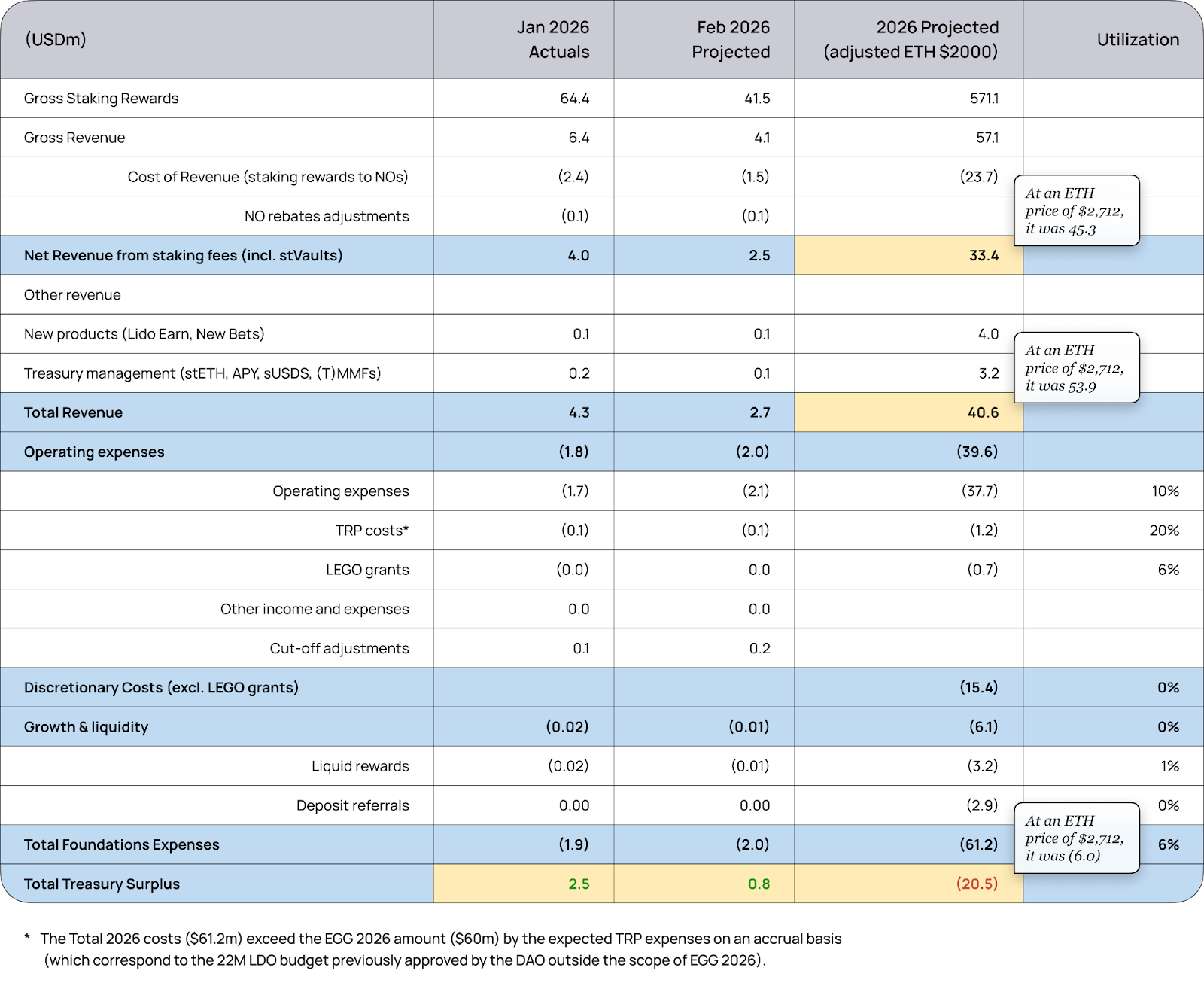
These 2026 projections are illustrative estimates based on current market conditions and available information. They do not represent forecasts or guarantees of future performance, and actual outcomes may differ.
Cost Discipline
Spending increases are on hold until the market settles, while growth and discretionary spending tied to revenue diversification continue.
2025 Year Wrap Up
2025 was a challenging year for the staking market, with ETH outflows, APR compression, and a shift in staking demand. The response involved:
- Foundations leadership and operational reset. A new leadership team was introduced at the end of Q2 2025.
- Cost discipline enforced. Total DAO expenses fell year over year and closed the year 25% below the initial 2025 grant request and 10% below 2024, as spending was actively adjusted to market conditions—reprioritizing protocol resilience, staking module economics, and diversified revenue sources.
Recap edition note: The savings figure shown during the February 26 livestream was based on an incomplete grant total.Aggregating all DAO grants requested totals $77M, excluding the 2023 rewards share used for deposit referrals. With deposit referrals classified as Cost of Revenue, total Foundations’ expenses come to $45.5M, with the year closing 41% below the requested amount.Grant requests for 2026 were submitted in a consolidated format to avoid similar issues and improve transparency.
TRP allocations fall under the 22M LDO ceiling approved by the DAO in 2023 and have not been included in annual grant requests since. In 2025, the TRP was transferred to Lido Labs Foundation under amended terms.
- Strategic reprioritization: Reduced reliance on pure staking growth and increased focus on protocol resilience, staking module economics, and diversified revenue sources, including the development of new products like Lido Earn.
2025 Financial Results
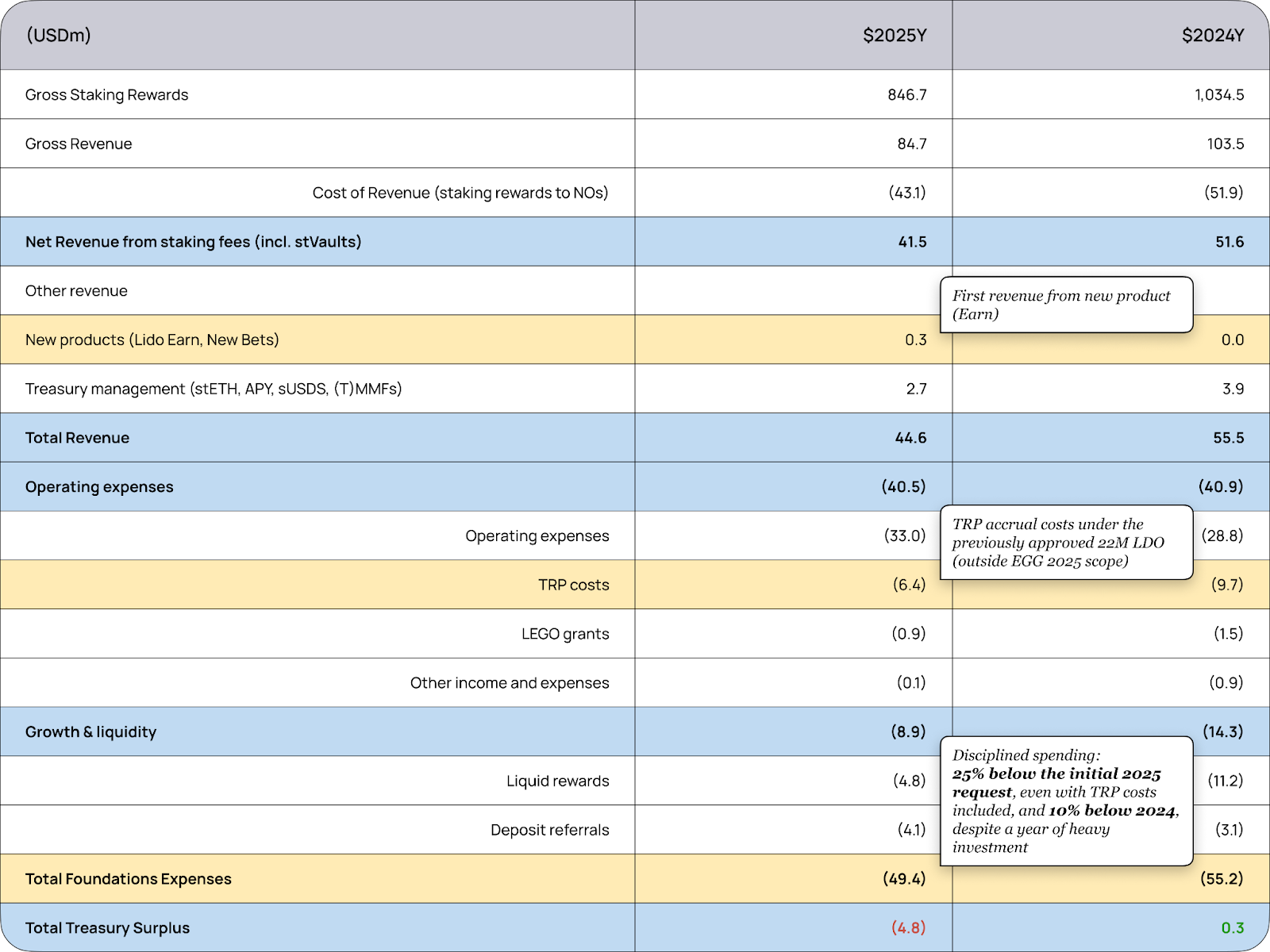
Financial results do not include LDO-denominated LEGO grants totaling approximately $0.2m. These amounts will be reflected in subsequent reporting.
Staking Achievements
- Permissionless Community Staking Module (CSM & CSM v2). Now the biggest permissionless staking module by ETH staked on Ethereum.
- Curated Module economics adjusted by tokenholder vote to be more in line with the current staking market, increasing DAO effective take rate by 23% (from 4.96% to 6.11%).
- Lido V3 launched, expanding the product line beyond Lido Core and creating potential for tailored staking products, including institutional use cases.
- WisdomTree ETP (live since December) — the first liquid staking ETP in Europe, with over $36M AUM.
- Expanded Node Operator set, onboarding hundreds of new operators, including home staker participation.
Governance and Tokenholder Alignment
- Dual Governance: Safety mechanism for stETH holders. It reduces counterparty risk for stETH holders posed by contentious LDO-governance decisions and is expected to support long-term institutional adoption.
Over the years, Lido DAO has treated alignment with tokenholders as a core design principle, reflected in its governance structure. As a result, LDO holders retain the following powers and safeguards:
- All protocol fees flow to the DAO Treasury
- Tokenholders retain exclusive authority over treasury allocations via governance process
- The DAO retains defined oversight and intervention rights over the grant-funded legal entities (Foundations)
- Foundations publish annual financial statements
These efforts are acknowledged by third-party assessments: See the Aragon Ownership Token Framework.
Automated Buybacks
The automated buyback mechanism, proposed on the Lido Research forum in November 2025, is currently under development for Q2 2026.
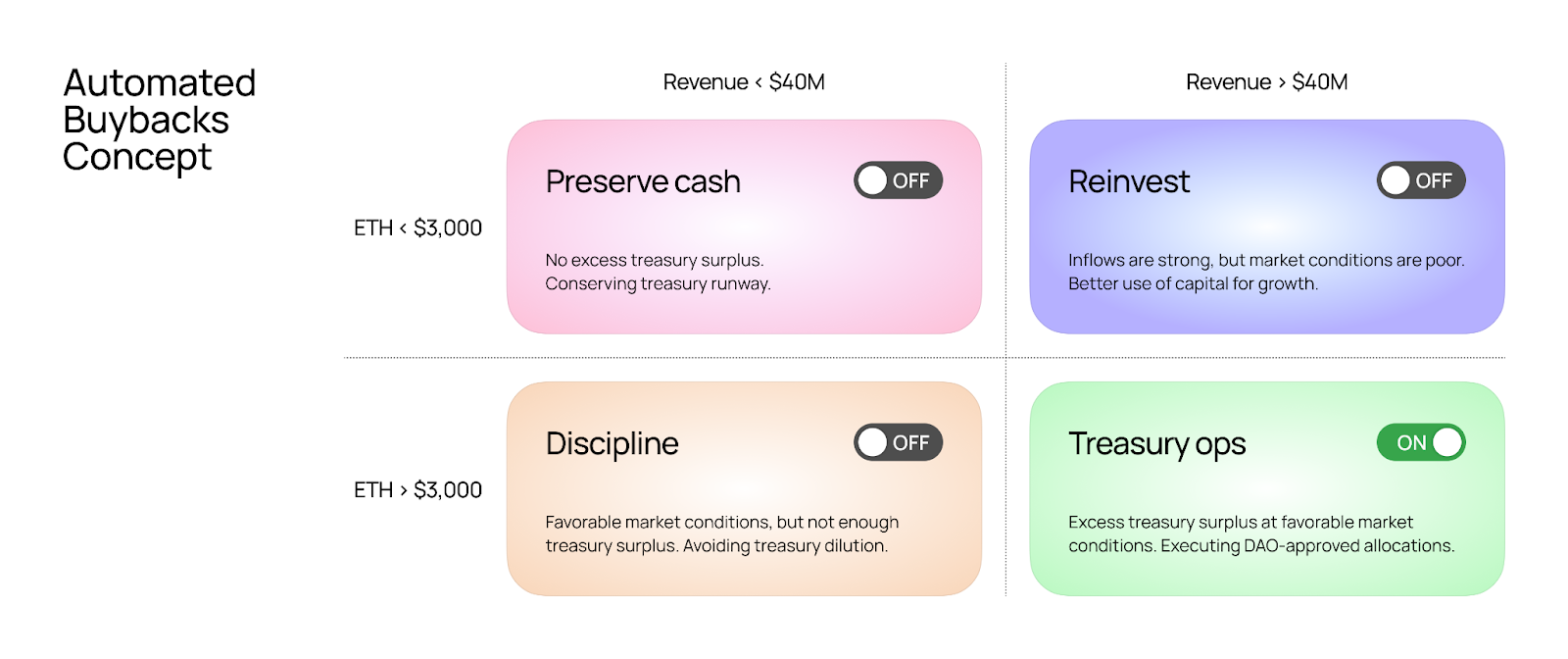
The proposed mechanism uses automated buybacks rather than staking to avoid unequal outcomes for tokenholders across different tax jurisdictions.
Activation Parameters, subject to DAO approval
- ETH Price: > $3,000
- Revenue: > $40M
- Annual Cap: $10M
- Daily Cap: TBD
The system acquires LDO using protocol-generated staking rewards and deploys an LDO/wstETH LP position held by the DAO via Aragon Agent.
Allocation Logic
- Total Allocation = min(50% x (Revenue - $40M), $10M)
- LDO Buyback: 50% of the allocation
- LP Deployment: remaining 50% converted to wstETH and paired with the LDO
Introducing automated buybacks creates a direct link between protocol performance and LDO. It activates only when market and revenue conditions are favorable, and scales with the protocol's success: as DAO revenue grows, so does the buyback allocation. The Foundations are now focused on delivering that growth.
Lido Market State
Staking Market Dynamics
Lido remains the largest staking protocol on Ethereum. Market share currently stands at 23%, with the decrease driven almost entirely by large players entering the staking market like BitMine and Grayscale.
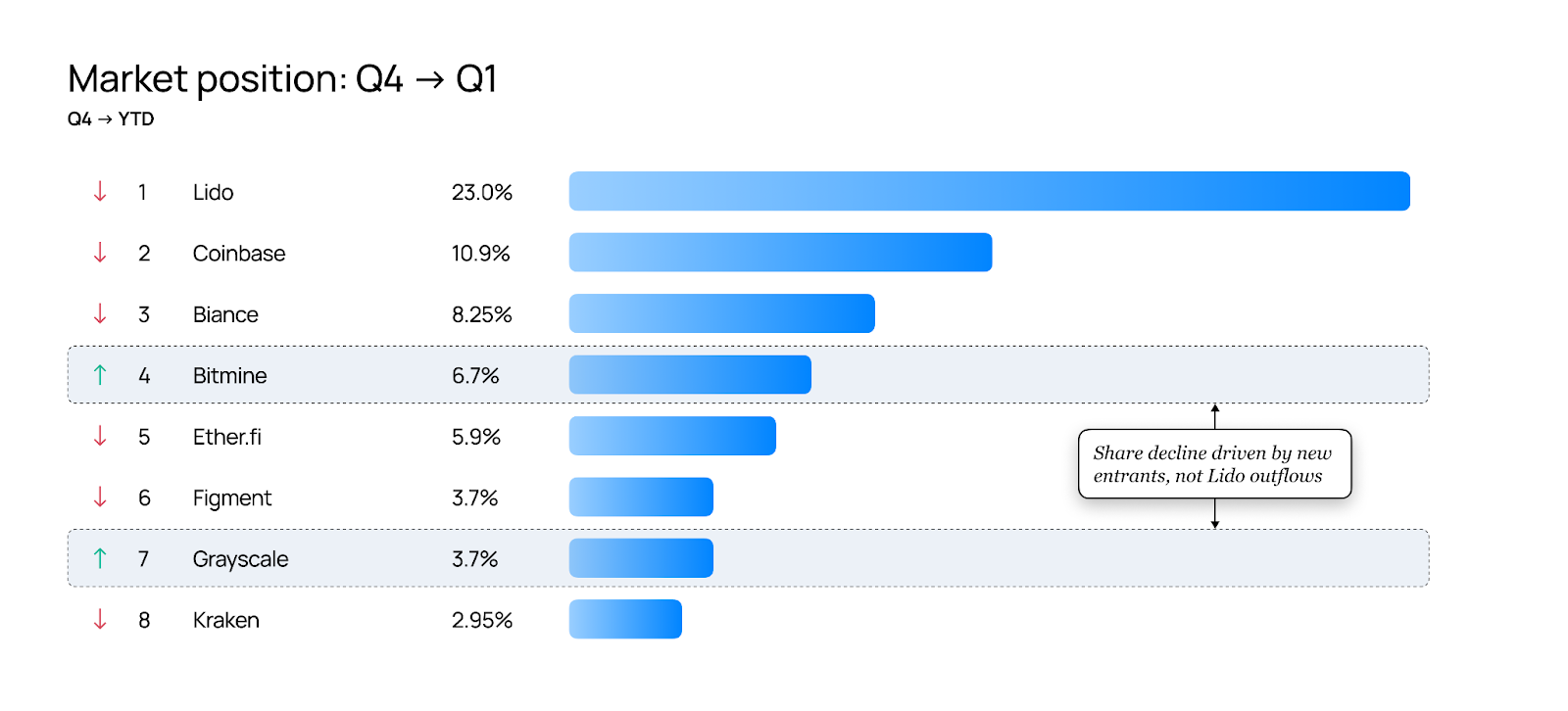
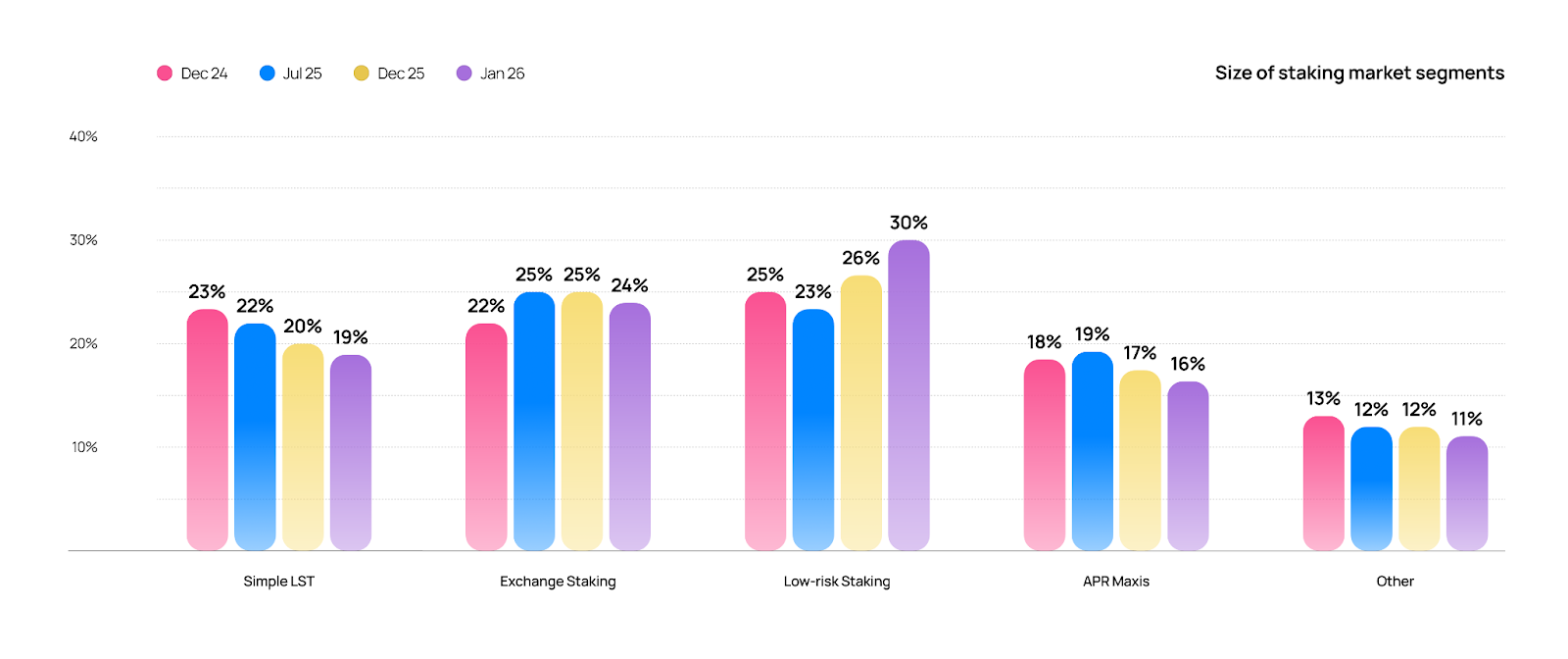
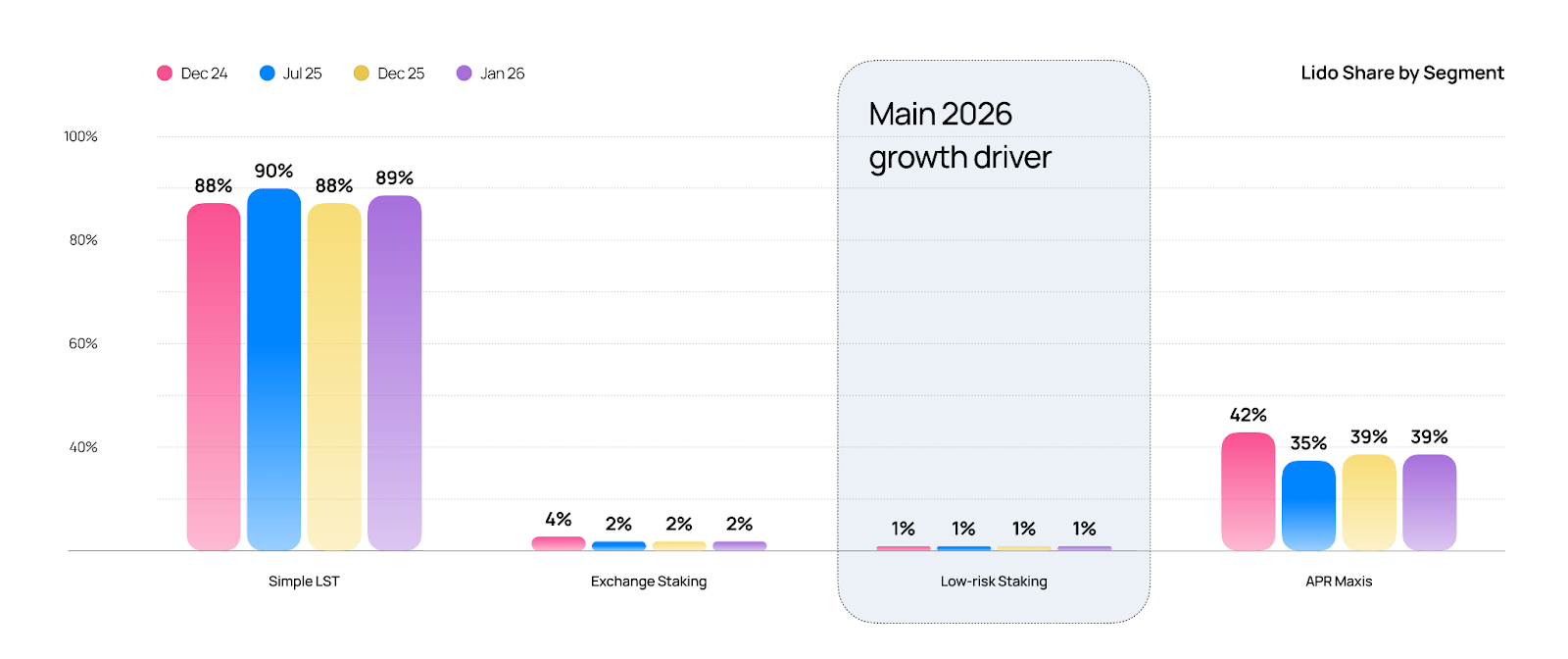
In absolute terms, Lido TVL has been growing since Q4 2025. Staking segment sizes remain stable, with the main expansion in the low-risk institutional segment — expected to continue through 2026, with BlackRock also exploring staking for its ETF. stVaults and institutional staking products are the primary focus for this segment.
stVaults
stVaults Phase 2 went live on January 29, and Phase 3, enabling permissionless minting, went live on March 02. The DeFi Wrapper is also live.
Early adoption has been limited by the long staking entry queue (~60 days) and integration timelines, as channel partners and builders work to launch end-user products. To mitigate this, a fee holiday on the infrastructure fee has been introduced for vaults above 250 ETH TVL.
For a closer look at stVaults and institutional products built on them, see the V3 Launch community call.
Lido Earn
Lido Earn holds approximately 61,000 ETH TVL (see queries one and two) with $1M ARR, as of February 26, 2026.
In March 2026 two new MetaVaults went live - one for ETH rewards and one for USD - powered by Mellow Protocol.
- EarnETH: Abstracts strategy selection across existing and future vaults. Users can upgrade to Earn ETH without withdrawals, with curated allocations across strategies.
- EarnUSD: Launches with a conservative and experimental set of sub-strategies, allowing USDC and USDT deposits.
Both will feature multi-curator setups with adaptive rebalancing, designed to offer wallet providers and other integrators a single, integration-friendly product.
To improve the Earn experience for users, a DAO proposal to allocate $5m in treasury funds to Lido Earn vaults was approved, to align the DAO with the Earn initiative. This safeguards users in severe scenarios by putting in place an onchain, first-loss alignment mechanism. More information can be found here.
Institutional Progress
- WisdomTree stETH ETP live, with ~$36M AUM
- Custodian integration progress for stETH and stVaults
- VanEck has filed for a Lido staked ETF in the US (filed, not yet approved)
Q2 2026 Focus
The main focus of the GOOSE-2026 strategic plan is growth. Q2 priorities:
- Institutional staking momentum, scaling liquid staking as a practical path for staked liquidity
- Expanding stVaults go-to-market
- Rollout of EarnETH and EarnUSD meta-vaults
- Developing automated buybacks
Q&A Highlights
If VanEck approval is delayed, how exposed is the institutional thesis for the Lido protocol?
Probably between 25% and 30% exposed. There is a broad set of institutional efforts beyond a single ETF filing — the WisdomTree ETP in Europe, interest from other issuers in the US and other geographies, DAT vehicles considering liquid staking holdings, and stVaults enabling institutional-forward products. A delay most likely pushes the thesis into further years rather than diminishing it in aggregate over time.
How many LDO tokens does Labs hold?
The Foundations do not hold LDO (besides dust-level amounts left from operational processes like TRP distribution). They do not participate in voting and cannot impact DAO governance decisions. They operate grant-to-grant, with the DAO retaining full control over funding. Individual contributors have LDO allocated through the TRP program.
Will Lido Labs reduce costs or headcount if staking revenue declines further?
Reducing headcount is not the right move at this stage. If ETH were to drop significantly lower — to around $1,000 — or stay at $2,000 for a prolonged period, that would require reconsideration. The current view is that this is a temporary setback, and it does not make sense to act preventively. Still, cost discipline remains strict: spending is gated until market conditions settle, while growth investments continue selectively.
For more insights, watch the full session covering detailed market share analysis, financials, and an extended Q&A.
Tokenholder Update call – Full Recording
Lido Poolside Community calls continue monthly, with Tokenholder Update ones held quarterly. Subscribe to Luma for updates on upcoming events.
This post is for informational purposes only and should not be construed as investment, financial, legal, tax, or other professional advice. The views expressed are those of the individual contributors and do not necessarily reflect the official position of Lido DAO. Past performance is not indicative of future results. Staking rewards are variable and not guaranteed — values fluctuate based on network conditions. Readers should conduct their own research and consult with qualified professionals before making any decisions. Nothing in this post constitutes a solicitation or offer to buy or sell any securities or other financial instruments.