Lido Validator and Node Operator Metrics: Q4 2025
Overview
- Permissionless participation accelerated: CSM reached its 5% stake share cap following the v2 upgrade, while 345 operators qualified for Identified Community Staker status, broadening independent participation in the Lido validator set.
- DVT scaled across all modules: 22,233 validators (711,456 ETH) now run using Distributed Validator Technology, strengthening fault tolerance and infrastructure diversity protocol-wide.
- Client diversity improved: No Consensus client exceeds 33% across the Lido validator set, and Execution Layer distribution remains balanced with five clients active across the Lido Staking Modules.
- Curated Set balanced: Validator allocation is now evenly distributed across 36 Curated Node Operators, reducing concentration risk and aligning with the 1% soft cap objective.
- Infrastructure matured: Validator density per node decreased by -14.5%, cloud reliance moderated, and hosting diversified, lowering correlated failure exposure.
The latest Q4 2025 VaNOM report is now live and available via the link.
Basic Stake & Operators Statistics
In late September, LDO tokenholders approved another cornerstone change for the Community Staking Module (CSM) in 2025, increasing its stake share limit from 3% to 5%, alongside the mainnet activation of v2 upgrade and the introduction of the Identified Community Staker (ICS) framework.

Since its activation, ICS has gained meaningful traction. By offering tailored conditions while maintaining transparent eligibility criteria, ICS lowers structural barriers for truly independent operators. This directly contributes to diversifying the operator composition and empowering decentralization within both the Lido protocol and Ethereum more broadly.
As of January 1, 2026, 482 applications had been evaluated with 345 approved, and 220 operators claimed their ICS status. The framework unlocks enhanced validation parameters, including a 6% reward share for the first 16 validators, deposit priority for the first 10 validators, a reduced bond requirement for the first validator, lower removal fees, and more flexible performance thresholds compared to the permissionless CSM operator type.
Following renewed deposit inflows, the CSM reached its new 5% stake share limit in December, marking +29.35% quarter-over-quarter (QoQ) growth. On an annual basis, the module added +377,664 ETH, demonstrating strong community interest toward permissionless validator participation in the Lido protocol.
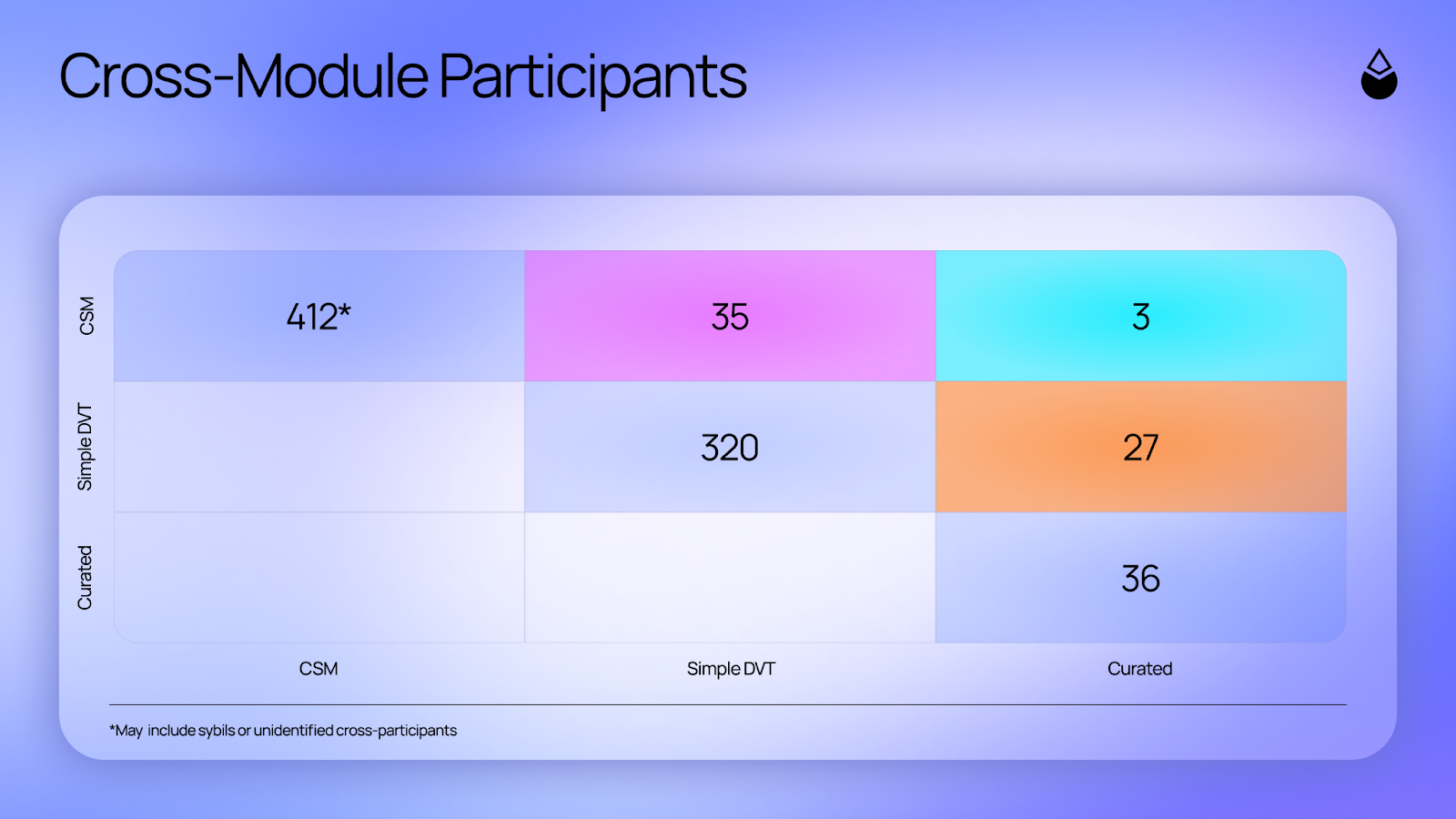
The operator composition within CSM remains predominantly independent. Of 412 active operators, 345 (83.74%) qualify under the ICS operator type. Additionally, 35 operators participate across both CSM and the Simple DVT Module, while three Curated Node Operators (NOs) — P2P, Stakely, and Launchnodes — also operate within CSM.
In December, the DAO also approved a module capacity adjustment to the Simple DVT Module (SDVTM), increasing its target stake share from 4% to 4.3%. This change addressed an allocation bottleneck: under the previous limit, the module could not simultaneously maintain its stake cap while completing validator allocations to clusters that had not yet reached their approved capacity (80 validators for regular clusters and 500 for Super Clusters). It ensures operational continuity and avoids underutilization of approved cluster infrastructure, reinforcing the protocol's ability to adopt Distributed Validator Technology (DVT) as planned.
As of January 1, 2026, these decentralized modules — CSM and SDVTM — collectively represented nearly 800,000 ETH, or 2.2% of total Ethereum stake. This marks a +0.53pp increase from Q3 2025, and nearly 3x from the end of 2024, underscoring measurable progress in diversifying Lido validator set over the course of the year.
December also brought notable changes within the Curated Module (CM). A41 announced its decision to wind down node operations across all networks and requested that the Lido DAO reduce its validator limit to zero, enabling the protocol to process exits through the validators run by them.
At the same time, Pier Two — previously operating 3,766 validators — was allocated 3,200 additional validators, bringing its total to 6,966 by year-end. This increase brought Pier Two’s validator count in line with other operators in the Curated Module, improving stake distribution balance within the module.
By the end of 2025, the Curated Module exhibited an exceptionally balanced distribution, with a Gini coefficient of 0.001 and an HHI of 0.0278, reflecting near-equal stake allocation among participating Node Operators, with each of the 36 active Curated NOs operating 6,967–6,967 validators. This accounted for approximately 0.71% of total Ethereum validators, well below the 1% soft cap defined in the Lido Scorecard and Operator Set Strategy. For further details on Gini and HHI, see the Glossary in the VaNOM Appendix.
This achievement represents a structural improvement in stake distribution within the Curated Module. While remaining the largest Lido Staking Module (SM), its internal allocation now demonstrates significantly reduced concentration risk and stronger alignment with the protocol’s long-term decentralization objectives.

Validator Set Client Diversity
Lido validator set continues to maintain a balanced distribution across both Consensus Layer (CL) and Execution Layer (EL) clients. While distribution varies by module design and operator composition, the broader picture remains clear: Lido maintains a stronger client balance than the pan-Ethereum average, showcasing its commitment to reducing correlated failure risks and contributing to Ethereum’s overall resilience.
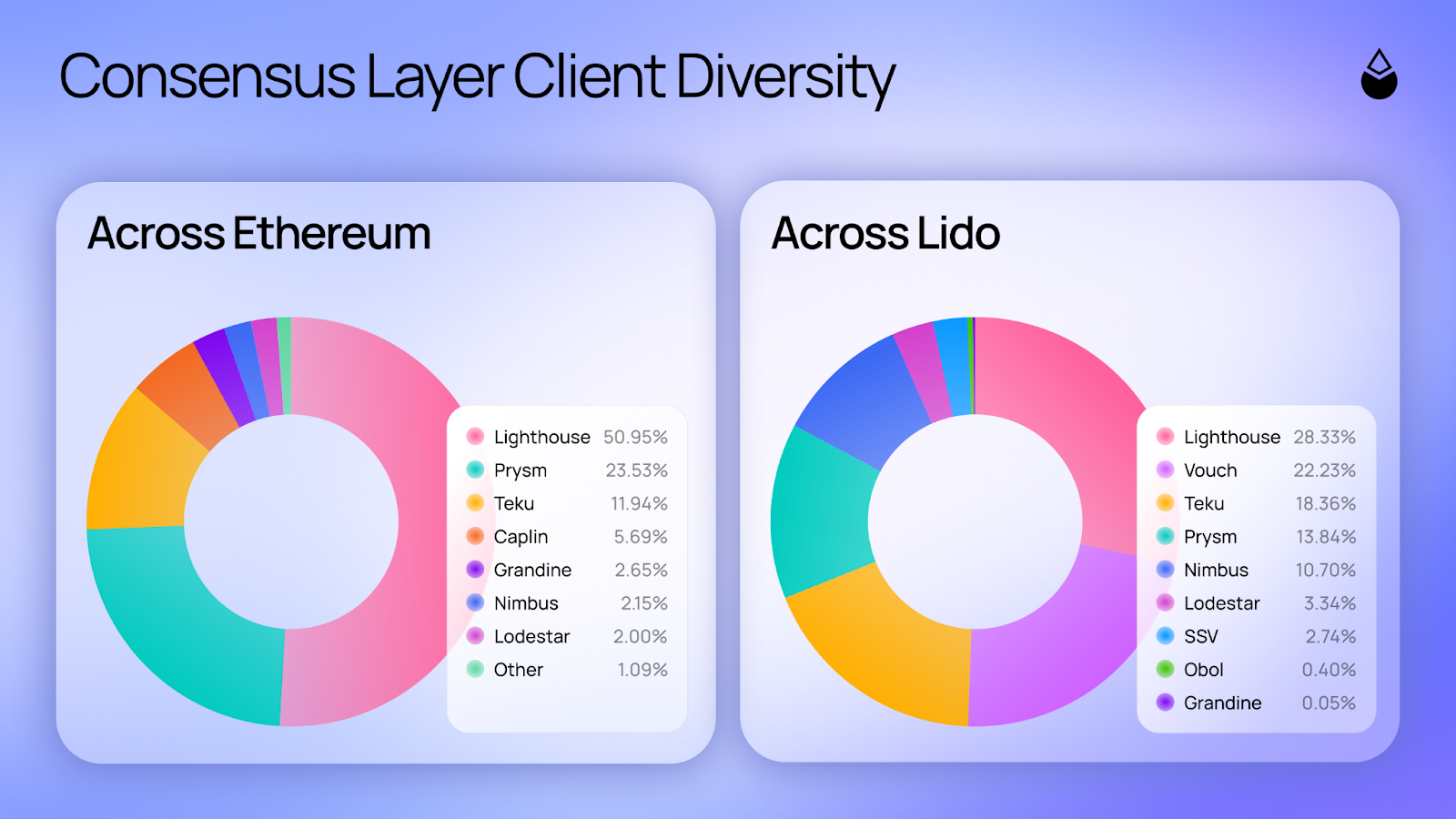
Compared to the broader CL landscape — where Lighthouse remains dominant at 50.95% (up by 5.03pp year-over-year (YoY)) — Lido validators reflect a more meaningfully distributed profile. Within the protocol, no Beacon Node (BN) client exceeds 33% of the validators, mitigating supermajority and finality risks arising from excessive client concentration. Multi-node setups now represent more than a quarter of validators (27.86%), an increase of +4.72pp, largely driven by DVT adoption within the Curated Module.
At the module level, Curated and Community Staking Modules strike the best balance, with the most popular clients, Lighthouse and Nimbus, accounting for 27.53% and 35%, respectively. Within the SDVTM, Lighthouse continues to lead with 52.63% of validators, although this is down 3.87pp from the past year.
Improving EL client diversity has remained a sustained focus for Lido DAO contributors and Node Operators since the Merge in Q3 2022. Since then, deliberate efforts — both Node Operators’ and governance-driven — have steadily reduced dependency on a single dominant client.
As minority clients stabilized and matured post-Merge, NOs expanded their Lido Execution Layer configurations accordingly. This process became increasingly transparent in early 2024, when Curated Node Operators began publicly sharing their commitments on the Lido Research Forum to further reduce majority client exposure.
Two years later, the impact is measurable. Across the Curated Module, no EL client holds a supermajority:
- Geth has structurally reduced to 37.0% ( roughly half its share at the end of 2021).
- Nethermind has remained stable at ~39% in 2024–2025.
- Besu accounts for 18.7% (a modest decrease of -0.5pp QoQ and -1pp YoY).
- Reth continues its steady growth since first adoption in Q3 2024, reaching 4.7% this quarter.
Erigon remains low at 0.6% (-3pp compared to the end of 2024), following earlier rotations by Figment and Stakely toward Reth, Geth, and Nethermind.


The top five EL clients are also consistently represented across both the CSM and Simple DVT modules. In Simple DVT, Nethermind remains the most widely used client at 54.51% (-6.61pp compared to year-end 2024). In CSM, Nethermind accounts for 60%, followed by Geth, Besu, Reth, and Erigon (21%, 14%, 3% and 1% respectively).
While Nethermind retains a leading position in the decentralized SMs, the broader EL landscape across Lido validator set remains multi-client, thanks to the Curated set, operating 91.09% of the protocol stake, where distribution is more structurally balanced with four EL clients meaningfully active.
The heatmap below illustrates how validators are distributed across combinations of EL and BN clients. Each cell represents the number of validator keys operated under a specific EL/BN pairing, with darker shading indicating greater adoption.
This view highlights real-world operator preferences and compatibility trends, showing not only which clients are popular individually, but which combinations are most commonly deployed at scale. The diversity observed across these pairings further reduces correlated client risks and strengthens the robustness of Lido validator ecosystem.

Distributed Validator Technology Adoption
By the end of 2025, DVT was utilized across all Lido Staking Modules, powering 22,233 validators representing 711,456 ETH. This marks a +537,792 ETH increase year-over-year, or over four times growth. In total, Lido DVT-powered validators account for 1.99% of total Ethereum stake, making a meaningful protocol-level contribution to Ethereum’s resilience through DVT-based infrastructure.

A major driver of this growth was the accelerated adoption of Obol and SSV Network within the Curated Module, following Lido DAO approval of intra-operator setups. Expanding DVT adoption by extending DVT beyond Lido decentralized modules into the largest staking module strengthens fault tolerance and represents a structural enhancement to Lido validator architecture.
- Obol (Curated Module): 100 → 1,100 validators (11x growth vs Q3 2025)
- SSV Network (Curated Module): 4,800 → 7,550 validators (1.5x growth quarter-over-quarter)
As a result, combined DVT utilization across Curated validators reached 3.45%, with continued testing and staged mainnet adoption expected to increase this share further.
By the end of 2025, all 70 Regular clusters and 10 Super Clusters of the Simple DVT Module became fully allocated. Compared to Q3, this represented an additional +80 Obol and +38 SSV Network validators, bringing the module to its governance-approved allocation and accounting for 4.0% of the Lido protocol.
Within the Community Staking Module, where DVT utilization remains fully voluntary, its adoption also expanded meaningfully. Compared to Q3, 1,249 additional validators (+78.45%) adopted Obol or SSV Network solutions. Among CSM operators who reported infrastructure choices, 35.38% utilize DVT-based setups. Although SafeStake — used only within CSM — announced it would cease operations, its footprint was limited to 4 operators running 8 validators, resulting in no material impact on overall DVT adoption.
In 2025 DVT became a widely adopted operational choice among Lido Node Operators of different types. Beyond its internal impact, Lido growing DVT adoption contributes to broader ecosystem-level validation of distributed validator infrastructure. By deploying DVT across multiple Staking Modules, Lido helps stress-test implementations under real economic conditions and production workloads. Collectively, the protocol DVT share stands at 8.36%, strengthening Lido contribution to a more decentralized, diversified, and robust Ethereum validator ecosystem.
Infrastructure: Servers & Hosting Mix
As of the end of 2025, Lido Node Operators collectively utilize 658 node, representing a +14.6% increase over the year. At the same time, density declined by -14.5%:
- Average validators per node: 381 (-25% from 2024)
- Maximum validators per node: reduced from 8,147 to 6,967
This shift reflects a structural improvement in operational risk management. Fewer validators per node reduce correlated downtime risk in the event of hardware or hosting failures, contributing to stronger validator-level resilience across the Lido protocol.

While Public Cloud remains the most widely used hosting option in the Curated Module at 47.7%, its share decreased by 3.8pp year-over-year from 50.5%, with a corresponding shift toward dedicated servers, which grew to 26.44% (+4.04pp) in Q4 2025.
Provider diversity remains stable overall, though several notable shifts occurred:
- AWS validator keys decreased from 58K to 41K, likely influenced by multiple AWS-related incidents during Q4 2025. Importantly, despite AWS hosts 34% of Curated Module validators running on public cloud infrastructure, none of major outages impacted the Lido protocol, and all Node Operators maintained near 100% uptime.
- GCP server count doubled, while key allocation remained stable.
- OCI expanded from 2 to 9 servers.
- Huawei usage nearly exited the Set.
This measured rebalancing suggests Lido Node Operators are proactively diversifying hosting exposure rather than concentrating further within cloud providers, which is a positive signal from a decentralization and operational risk perspective.
A similar reduction in Public Cloud reliance occurred within the Simple DVT Module, where cloud usage declined by 4.22pp to 12.9% by the end of Q4 2025. Similarly to last quarters, dedicated servers remain the dominant infrastructure choice at 60.67%. Home nodes (9.00%) and Colo setups (8.44%) remained stable quarter-over-quarter, representing continued participation of independent solo and community stakers within the Simple DVT Module.
Within the CSM, Home nodes remain the most common hosting choice, underscoring the module’s permissionless and community-oriented focus. At the same time, a modest increase in Managed Servers (7.81%) and Public Cloud usage (3.21%) reflects participation from professional staking providers drawn by attractive staking terms.
Reducing validator density per machine, diversifying cloud exposure, and maintaining meaningful participation across home, colo, and dedicated environments collectively reduce correlated failure domains within the Lido validator set.
Geographic Distribution
The map below presents unified validator distribution data across all Lido staking modules. For the Community Staking Module, geographic data is self-reported and therefore reflects only operators who chose to disclose their infrastructure location. Validator distribution is based on primary server locations, with darker shades indicating higher validator concentration.
Within the Curated Module, the overall geographic footprint remained stable throughout 2024. Germany and the United States continue to host the largest number, with 48,402 and 32,397 validators respectively. While both jurisdictions saw a modest decline in validator counts, their relative leadership remains unchanged.
The most notable growth was observed in Australia, where validator count nearly doubled following the additional allocation to Pier Two. This expansion meaningfully increased Asia-Pacific representation within the Curated Set, contributing to broader geographic dispersion.
Overall, while the Curated Module still reflects concentration in historically strong validator regions, incremental shifts indicate gradual rebalancing rather than consolidation.

Geographic distribution within the Simple DVT Module remained broadly stable across Europe, the Americas, and the Asia-Pacific regions, as clusters scaled toward their target validator capacities. Germany and Finland account for a meaningful share of validators, but the distribution remains multi-regional. The United States, United Kingdom, France, and Singapore continue to be well represented, while several previously underrepresented jurisdictions expanded their presence as clusters matured.
Among CSM operators who reported infrastructure locations, the top ten jurisdictions are:
- United States — 2,011 validators
- Germany — 965
- United Kingdom — 563
- South Korea — 461
- Canada — 389
- France — 237
- Spain, Netherlands, Switzerland, Czech Republic — above 100 each
Given that reporting is voluntary, these figures likely underrepresent total geographic dispersion. Nevertheless, the data suggests continued expansion of the validator footprint beyond traditional infrastructure hubs.
Geographic distribution plays a critical role in validator decentralization. Jurisdictional diversity reduces regulatory concentration risk, improves network liveness under localized disruptions, and strengthens Ethereum’s censorship resistance assumptions. Across 2025, Lido validator set maintained multi-regional representation while gradually expanding into new jurisdictions.
Looking Ahead
Zooming out, 2025 marked a continued evolution of the Lido validator set. Over the course of the year, decentralization advanced not through isolated minor improvements, but through coordinated progress across modules: expanded permissionless participation via CSM, bringing DVT adoption across Curated operators and more even stake distribution within the largest staking module, improved client diversity, reduced infrastructure density per machine and geographical distribution.
Taken together, these changes reflect a validator ecosystem that is not only more performant, but more distributed across operators, infrastructure, geographies, and software implementations, which strengthen Lido contribution to Ethereum’s long-term resilience.
Looking ahead to 2026, further diversification is expected on multiple fronts. The proposed design of CMv2 introduces the ability to create multiple sub-operator profiles of different types under a single entity, including Decentralization Operators, Extra Effort Operators, and Intra- and Multi-Operator DVT Clusters. These configurations are designed to support individual Node Operator’s contributions that enhance decentralization and broader ecosystem robustness, while maintaining risk controls through calibrated bond requirements and performance guardrails.
At the same time, a potential future expansion of the CSM toward a 10% stake share, alongside continued growth of the number of operators that qualify for Identified Community Staker (ICS) type, is expected to further broaden permissionless participation and bringing more independent operators into the Lido validator set.
As always, Lido DAO contributors will continue to refine the protocol’s metrics and dashboards to reflect its growing complexity and ensure data-driven accountability. Explore the latest Q4 2025 VaNOM dashboard, revisit previous reporting periods, and stay tuned for the next update.
In the meantime, check the Validator Set Updates for ongoing monthly insights into the evolution of the Lido validator set.