Lido V3 Is Live: Modular Infrastructure for a New Paradigm of Ethereum Staking
TLDR
- Lido V3 is live on Ethereum mainnet, introducing stVaults: modular staking infrastructure for builders, powered by stETH.
- Institutions can deploy segregated vaults with dedicated validator infrastructure and optional stETH liquidity.
- Node Operators can move beyond traditional delegated staking and build differentiated offerings with a range of fee structures, APRs and operational setups.
- Builders can design vaults with DeFi Wrapper for integrated yield strategies, or custom strategies, including looped staking and curated DeFi.
- Platforms, such as Layer-2 protocols, can embed staking into existing user flows, turning bridged ETH into a productive asset.
- These use cases share a common layer via stETH, preserving composability and liquidity across Ethereum DeFi.
A New Primitive for Staking Businesses
Lido V3 is live on Ethereum mainnet.
The mainnet launch follows a long path of staged validation, including multiple public testnets, security reviews, and a mainnet soft-launch. Lido contributors designed the public launch process to deliver the same qualities that make Lido Core durable: a relentless focus on security, including multiple public audits, community input, and a commitment to open software.
This release extends the Lido protocol with the introduction of stVaults, a modular staking primitive designed for stakers that need configurations beyond a single pooled model, while still benefiting from stETH’s liquidity and network of integrations.
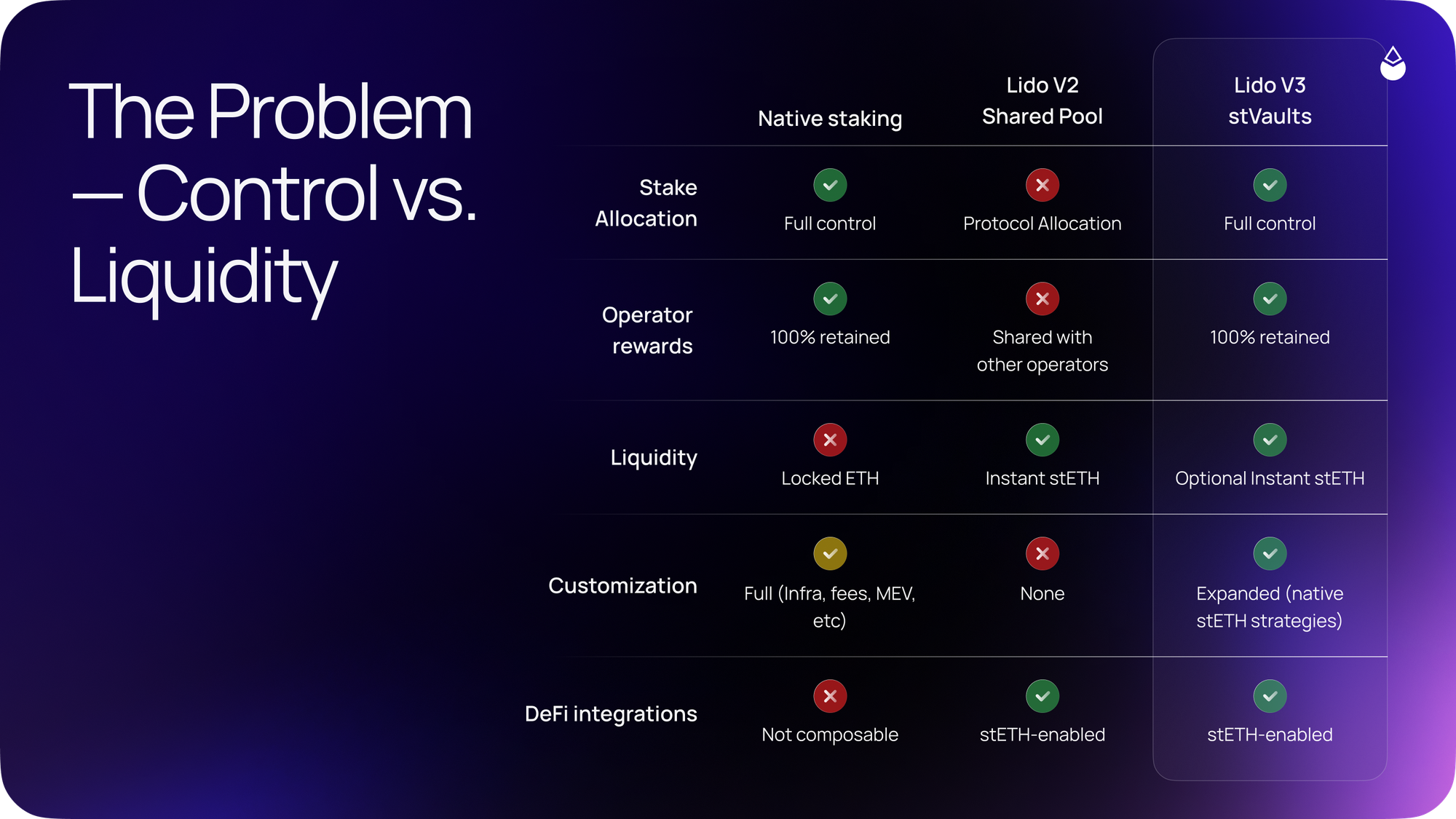
Until now, stakers have faced a structural trade-off:
- Choose pooled liquid staking for liquidity, simplicity, and DeFi utility, but accept limited customization.
- Choose bespoke staking setups for control and policy requirements, but accept operational complexity and illiquidity, subject to Ethereum’s entry/exit queue.
stVaults resolve the dilemma between bespoke control and liquid utility. They allow customization where it matters (operator selection, policies, fees, reward logic, and risk parameters) while maintaining access to a shared liquidity layer through stETH. stVaults bring a new paradigm to Ethereum staking offerings by enabling any team to build a staking business using the most powerful network effects in DeFi.
From Pooled Liquid Staking to Composable Staking Infrastructure
Lido Core proved a simple point: pairing staking with a liquid token unlocks powerful market forces. stETH made staked ETH usable across DeFi for lending, collateral, LP positions, and other strategies, without locking stakers into withdrawal queues as a hard constraint.
Lido V3 extends that idea to a wider set of staking models.
With stVaults:
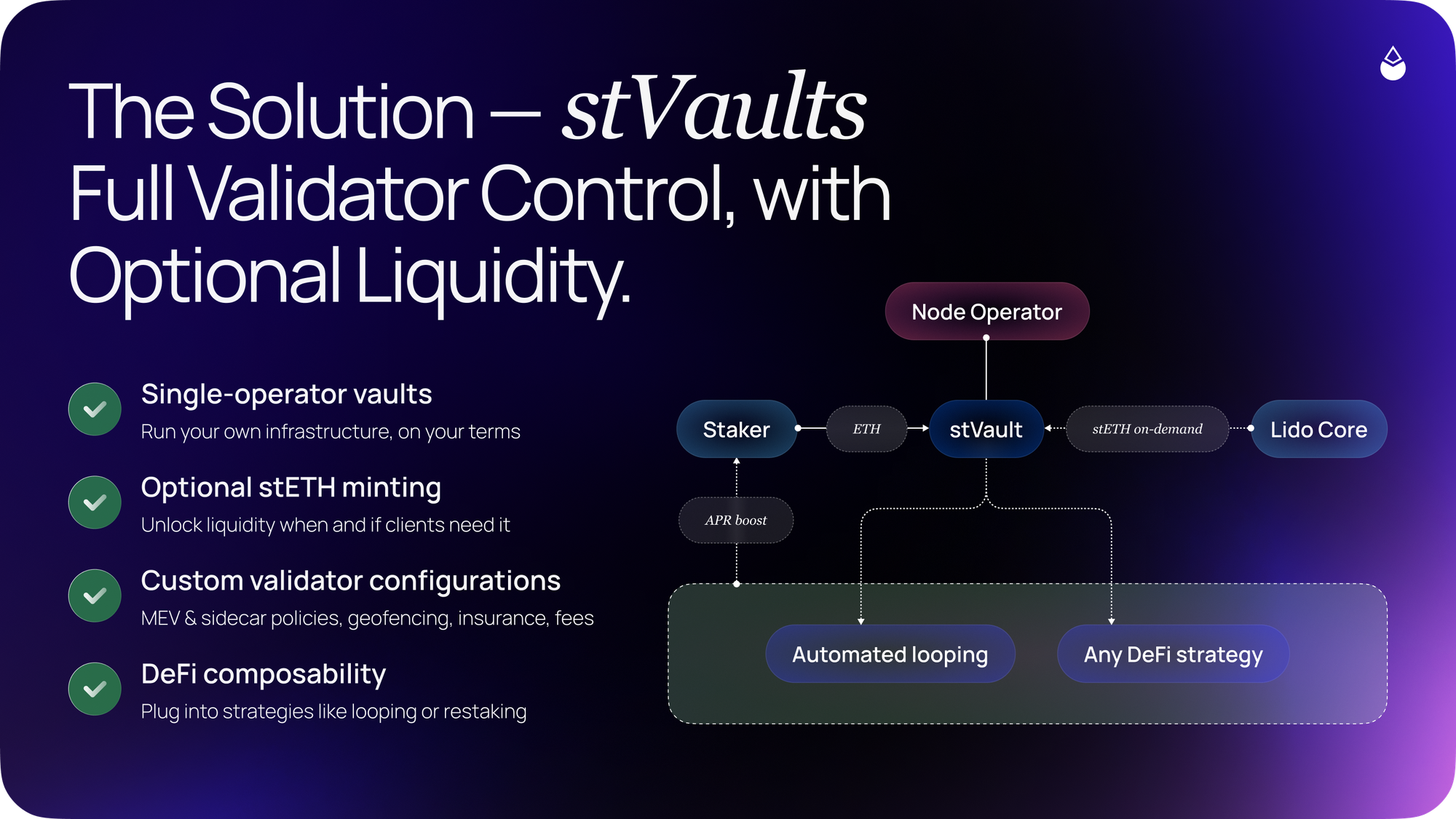
- Vault owners define the staking setup (operators, operating requirements, fee design, risk/reward choices).
- Staked deposits can mint stETH, keeping staking positions usable across DeFi even when the underlying validator configuration is bespoke.
- Diverse staking products can coexist while contributing to and benefitting from stETH’s network effects.
This structure supports a new paradigm of staking businesses: one that includes regulated institutions, differentiated operator offerings, and builders who need specific controls.
Institutional Staking Without Compromising Liquidity
Many institutions already use liquid staking, yet in some cases they require bespoke setups defined by:
- Operator segregation and auditability,
- Known counterparties and jurisdictions,
- Defined operational controls,
- and, increasingly, liquidity.
Traditional staking models often fail modern asset managers because long exit queues and illiquidity risk do not fit treasury and fund requirements. stVaults support this by enabling segregated vault structures with dedicated validator infrastructure, while still offering optional stETH liquidity.
Early stVault deployments illustrate the new design space:
- Northstake uses stVaults as the foundation for its Staking Vault Manager (SVM), enabling institutions to stake ETH natively across multiple vaults and operators while preserving asset segregation and on demand stETH liquidity.
- Solstice deploys segregated stVaults for compliance-sensitive clients, offering dedicated vaults with funds separation and full traceability, while using Lido V3 to deliver conservative yield strategies and access to the stETH ecosystem.
The result: institution-grade staking controls without forcing a hard choice between customization and liquidity.
Operator-led Staking Products and Clearer Differentiation
Lido V3 also changes the business case for Node Operators. In the pre–stVaults world, operators largely chose between:
- contributing to liquid staking pools like Lido Core, or
- running delegated setups that often struggled with illiquidity, cumbersome exits, and limited DeFi utility.
stVaults create room for operator-led products: vaults mapped to specific validator infrastructure, with customized operational policies.
For example, P2P.org is building dedicated stVaults that let institutional clients stake through segregated vaults linked to P2P.org’s validator operations, supporting customization, and transparent performance reporting. The same stVault foundation also enables a broader range of products, spanning conservative staking exposure and more advanced, curator-driven DeFi vault strategies built around stETH.
stVaults give operators new levers to compete on what matters: price, performance, and vault configuration.
Strategy Design and DeFi Wrapper Product Tooling
stVaults also expand the design space for staking strategies. Early examples include:
- Looped staking strategies that redeploy staked assets through lending/borrowing markets to compound rewards while maintaining access to liquidity (e.g., Chorus One’s approach).
- Market-neutral designs that separate validation from risk management, pairing staking operations with policy enforcement and hedging mechanisms to reduce directional exposure while seeking additional yield (e.g., Everstake’s approach).
A second novelty sits alongside strategy flexibility: tooling that reduces time-to-market for teams launching user-facing staking products.
Lido V3 includes the “DeFi Wrapper” toolkit aimed at low-code deployments of end-user staking products. The toolkit includes:
- set of contracts wrapping the stVault and enabling pooled staking,
- connectors to Yield-boosting strategies (GGV on launch),
- white-label UIs for branded distribution, and
- custom ERC‑20 vault tokens so teams can productize their vaults for wider distribution.
Builders can choose either to utilize pre-integrated curated strategies to ship differentiated products without building curation strategies from scratch, or to integrate custom strategies that enable unique competitive advantages in the products for specific segments and markets.
Embedded Staking for L2s
stVault modularity also enables staking to move closer to where users already hold ETH.
L2s can route bridged ETH into staking and use the resulting yield to support ecosystem incentives or liquidity programs, without introducing a new user journey.
Work in this direction includes L2 implementations from Linea, that show how staking can become part of network economics while preserving familiar user flows.
This pattern matters because it treats staking as infrastructure: a yield-bearing base layer that protocols can integrate, not just a standalone action users must take explicitly.
Start Building on Lido V3 Today
Lido V3 turns liquid staking from a single product category into broader infrastructure for staking businesses.
stVaults make it possible to:
- design staking setups that fit the needs of a new set of customers,
- maintain optional liquidity through stETH,
- and keep access to Ethereum’s DeFi ecosystem.
Reach out to Lido contributors if your team is building institutional staking products, operator-led offerings, structured DeFi vaults, or L2-native staking integrations.
Due to the length of the Ethereum entry queue, contributors are offering an early adopter campaign. Until March 31st 2026, the stVaults Lido Infrastructure fee will be reduced from 1% to 0%. This promotion applies to identified vaults with a Total Value exceeding 250 ETH. Contact the stVaults team to start building stVaults today. For more information on this campaign, refer here.
Start building on Lido V3 today with the stVaults Documentation Center.
For more details on key concepts including Reserve Ratios, risk tiers, and forced rebalancing, see the Lido V3 Whitepaper.