Lido Poolside Recap: Tokenholder Update, May 2026
The May 2026 Lido Poolside Tokenholder Update covered the state of the staking market, Lido protocol Q1 financials, the impact of the Kelp DAO rsETH incident in April on the market and Lido protocol specifically, an assessment of 2026 targets, a deep dive into protocol security features, and next steps for Lido DAO.
Read the highlights below or watch the full recording.
Agenda
- Financials & Execution
- Kelp Incident Response
- Tokenholder alignment and LDO Buybacks
- State of the Market
- Security Stance
- Next Steps
Key Points
- Q1 closed with a $3M treasury surplus, delivering three consecutive months of positive operating results despite challenging market conditions.
- When April's bridge exploit at Kelp DAO left rsETH significantly underbacked, Lido DAO joined the industry-wide DeFi United response, contributing 2,500 stETH and activating EarnETH's first-loss protection (144 ETH burned). As a result, EarnETH depositors faced no losses. EarnETH is now operating normally.
- The 2026 annual targets established in December are no longer achievable given current market conditions. The Lido Foundations are cutting back on their spending for staking objectives, prioritizing profitability in staking, and are also exploring new products that build on the security expertise of Lido contributors.
- New product preview: Wisp is a privacy-first agent system built around local controls and attested TEE execution: the waitlist is now open.
- Security is being repriced across DeFi after a string of major exploits this year. No Lido staking user funds have ever been lost in five years of operation, and the protocol carries top-tier third-party security ratings (Web3SOC Grade A; Credora and StakingRewards A+). This supports the strategic direction toward new products that leverage Lido protocol’s brand in security.
- The Automated LDO buyback design and parameters were approved via Snapshot vote, with onchain deployment expected in July 2026. Batch #1 of the LDO Accumulation program deployed 471 stETH into LDO at an average price of $0.3745.
Introduction
Lido Protocol Fundamentals
Lido is the leading liquid staking protocol on Ethereum. Alongside liquid staking, the Lido ecosystem offers modular infrastructure for custom staking setups via stVaults, and DeFi-native yield strategies through EarnETH and EarnUSD.
The Lido protocol is governed by Lido DAO, a decentralized autonomous organization of LDO tokenholders. Through the governance process, the tokenholders set parameters, approve upgrades to the Lido protocol, manage Lido DAO Treasury allocations, define goals, and authorize grants, notably for the Lido Labs, Lido Ecosystem, and Lido Alliance Foundations (together the “Lido Foundations”).
Lido Foundations operate under defined DAO oversight and intervention rights and, by their bylaws, are required to follow tokenholder-approved directives. Lido Labs Foundation develops and maintains the protocol’s codebase, upgrades, and new features, while Lido Ecosystem Foundation leads ecosystem growth, partnerships, and business development for staking adoption; and Lido Alliance Foundation supports Lido's horizontal expansion and growth initiatives that fall outside the specific scopes of Labs and Ecosystem.
Financials
Lido Protocol: Operational Model
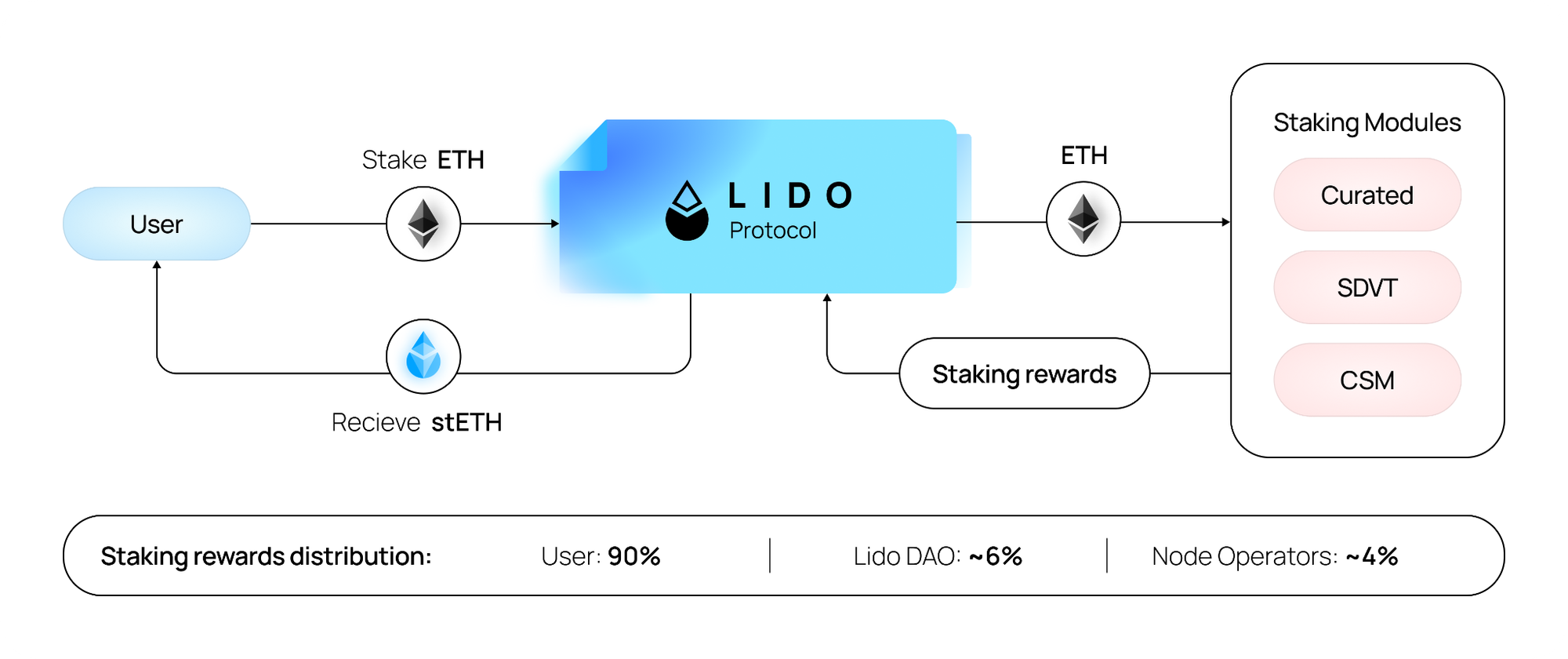
The Lido protocol’s core operational model remains unchanged. Users deposit ETH into the Lido protocol and receive stETH (staked ETH) in return, a liquid token that can be utilized across the broad DeFi ecosystem.
ETH is allocated through the Staking Router into various Staking Modules.
Ethereum staking rewards flow back to the Lido protocol, with 90% distributed to stakers, approximately 4% (depending on the Staking Module) allocated to Node Operators, and the remainder directed to the Lido DAO Treasury.
Financial Position: Q1 2026
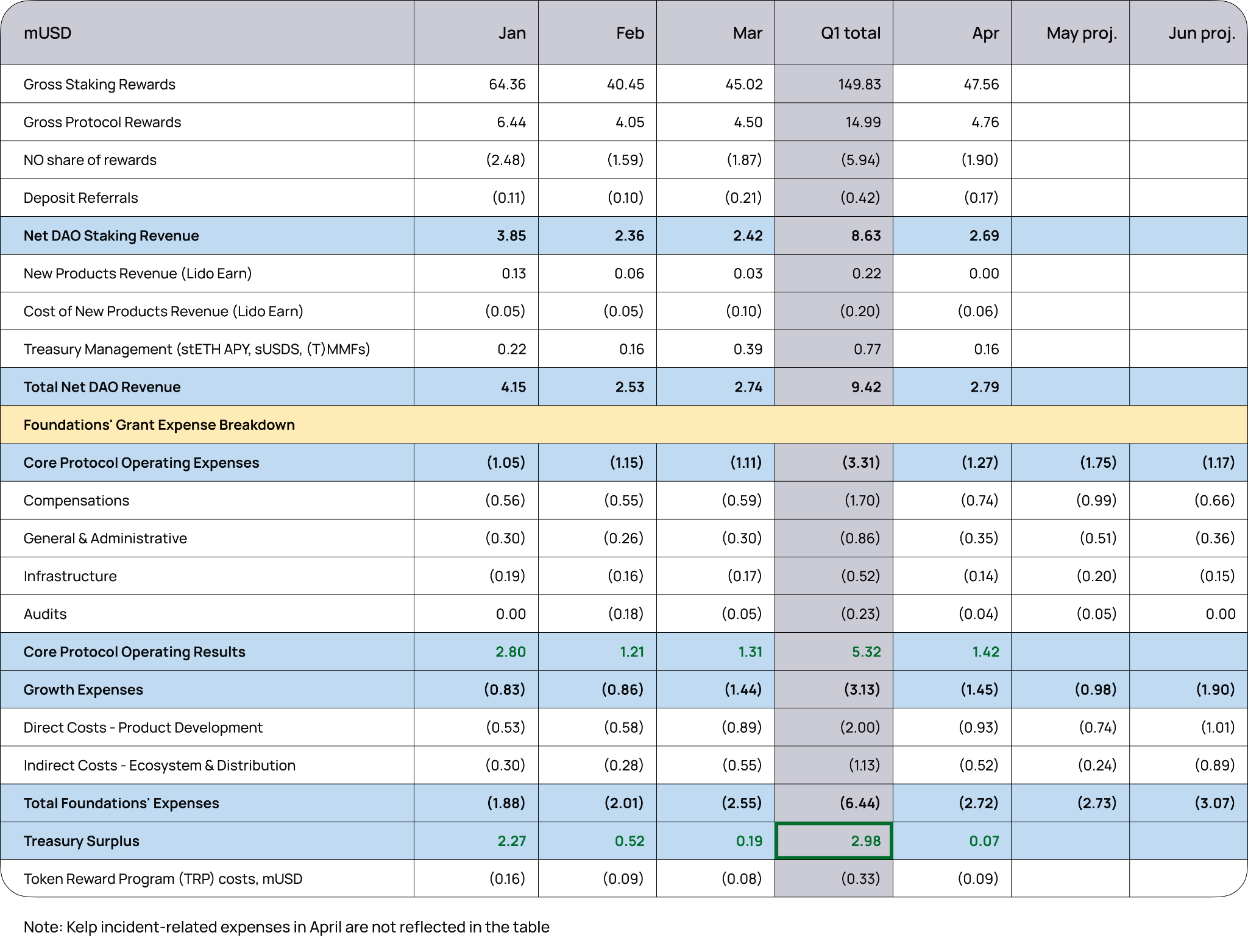
The DAO closed Q1 2026 with positive operating results in all three months despite challenging market conditions. Key reads from the table:
- $2.98M treasury surplus across Q1 (Treasury Surplus = Total Net DAO Revenue − Total Lido Foundations' expenses)
- $5.32M Core Protocol Operating Result for the quarter (Core Protocol Operating Result = Net DAO Staking Revenue − Core Staking Protocol Operating Expenses)
- Stronger unit economics: with the DAO take rate at an all-time high (~6.10%, +23%), net staking revenue grew despite ETH price headwinds (derived metric, not visible in the table below).
- Treasury Management contributed $0.77M to revenue in Q1 from the DAO's stETH APY, sUSDS, and (T)MMF positions.
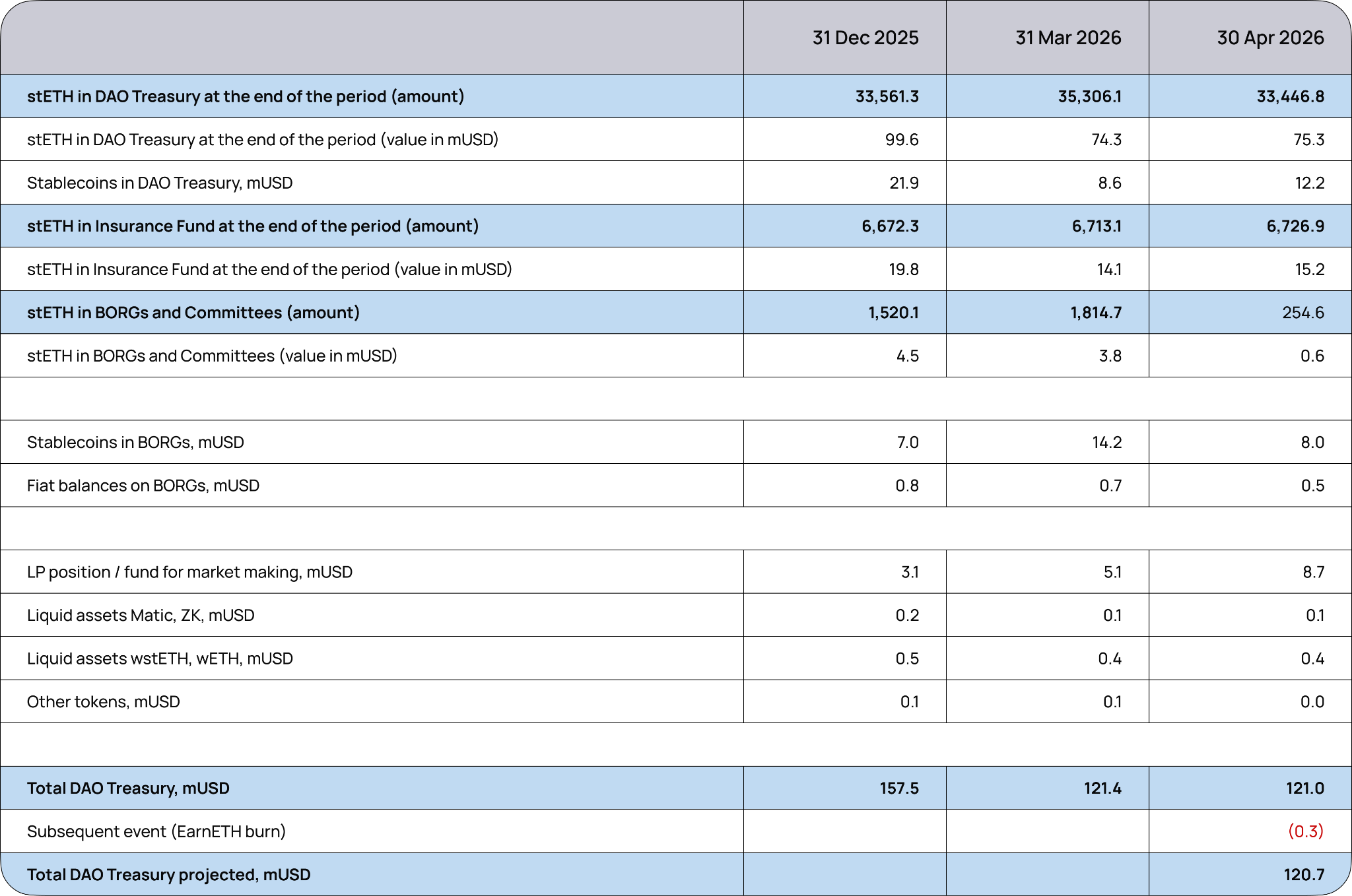
The DAO Treasury stood at approximately $121M as of April 30, 2026, down from around $157M at the start of the year. The decline of ~$36.5M was driven primarily by the ETH price effect on the DAO's stETH position (-$31.6M) and the DeFi United contribution (-$5.7M).
The April Kelp DAO Incident
A LayerZero bridge exploit left Kelp DAO’s rsETH underbacked by more than 100,000 ETH. At the time, the rsETH/ETH loop was one of the largest restaking positions on Aave, placing DeFi borrowers, lenders, and downstream protocols at risk. The EarnETH vault had direct rsETH exposure of approximately $20M.
Lido DAO joined a broader coordinated response: the DeFi United initiative, which raised approximately 132,000 ETH from Aave, Ethena, Mantle, Ether.fi and others. Lido DAO contributed 2,500 stETH (approximately $5.7M at the time of transfer) to the DeFi United effort and approved the burn of EarnETH shares valued at 144 ETH through EarnETH’s first-loss protection. Together, the two actions ensured EarnETH depositors faced no losses. The broader initiative also helped stabilize the affected markets.
The EarnETH vault was frozen for 27 days. The duration reflected a deliberate choice: until the DeFi United effort was resolved, the vault's damage could not be evaluated with certainty. The final outcome was 0% loss for depositors, whilst the worst-case scenario was up to approximately 12%. Letting users withdraw at no haircut before the resolution could have harmed those who remained in the vault if the rescue failed. Setting any haircut in advance would have harmed early withdrawers. The decision from the EarnETH vault’s curator was to wait for certainty on the damage; when it arrived, withdrawals unfroze.
EarnETH withdrawals are now unfrozen and operating normally. EarnUSD withdrawals were neither frozen nor affected by the incident.
For more context, see postmortem.
Updated Risk Policy for Lido Earn
Three risk policy changes are now in effect and shall be followed by the curator:
- Dependency-level risk review. Material allocations now receive a full-chain review across bridge, oracle, lending market, liquidity venue, unwind route, governance, and counterparty risks, plus a combined-failure stress test.
- Predefined unwind playbooks. Leveraged positions require documented exit paths before deployment.
- Formalized first-loss activation criteria. Clearer criteria determine when and how first-loss protection activates for future incidents.
The rsETH position in EarnETH is being unwound by the curator and is unlikely to meet the updated risk requirements. Future allocation decisions shall follow the systemic risk process.
Tokenholder Alignment & LDO Buybacks
A few properties continue to anchor the Lido protocol’s structural alignment with LDO tokenholders:
- All protocol fees flow to the DAO Treasury.
- Tokenholders retain exclusive authority over treasury allocations via the governance process.
- Lido Foundations are moving to quarterly financial reporting in 2026. The Q1 financial report is being finalized for June publication, and a detailed first-half business report is targeted for Q3.
- Automated buybacks are in development.
Taken together, these properties earned Lido a 12/12 score on the Aragon Token Ownership Index.
LDO Accumulation Program: Batch #1
Under the discretionary trade program approved by Lido DAO via Snapshot, 1,000 stETH was requested from Treasury for Batch #1. As of the call, 471 stETH had been deployed into LDO at an average price of $0.3745. Batch #1 closes May 29; full results will be posted to the research forum within a week of that date. Contributors will then take stock and propose the way forward, including refining parameters.
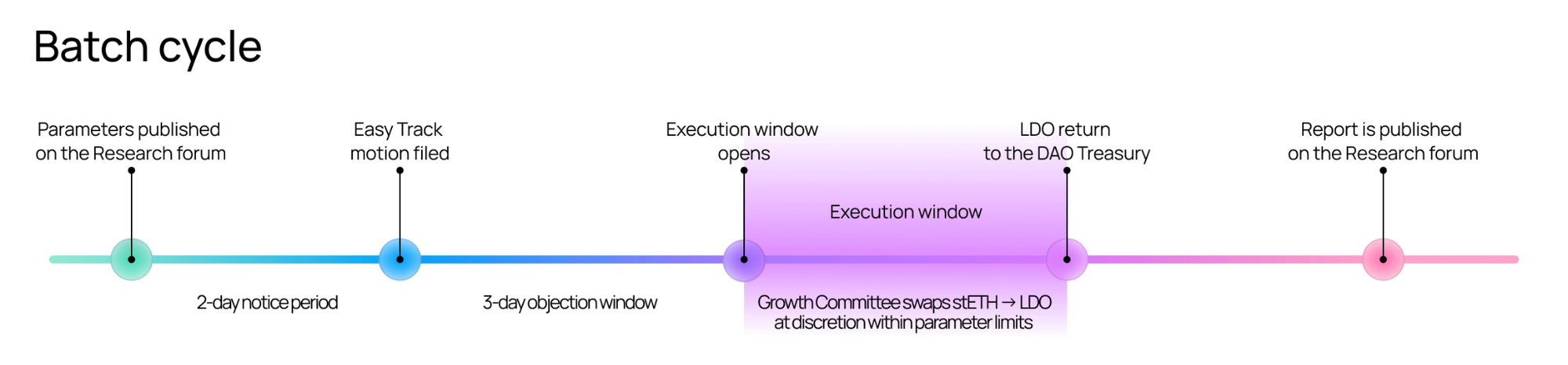
NEST Automated Buyback Architecture
Network Economic Support Tokenomics (NEST) is a rule-based onchain mechanism designed to acquire LDO when Lido protocol’s revenue and the market present favorable conditions. The mechanism establishes a direct link between protocol performance and LDO: when the DAO generates surplus, a portion is automatically deployed into LDO buybacks and DAO-owned LDO/wstETH liquidity.
Its design and parameters were approved by the DAO via Snapshot vote.
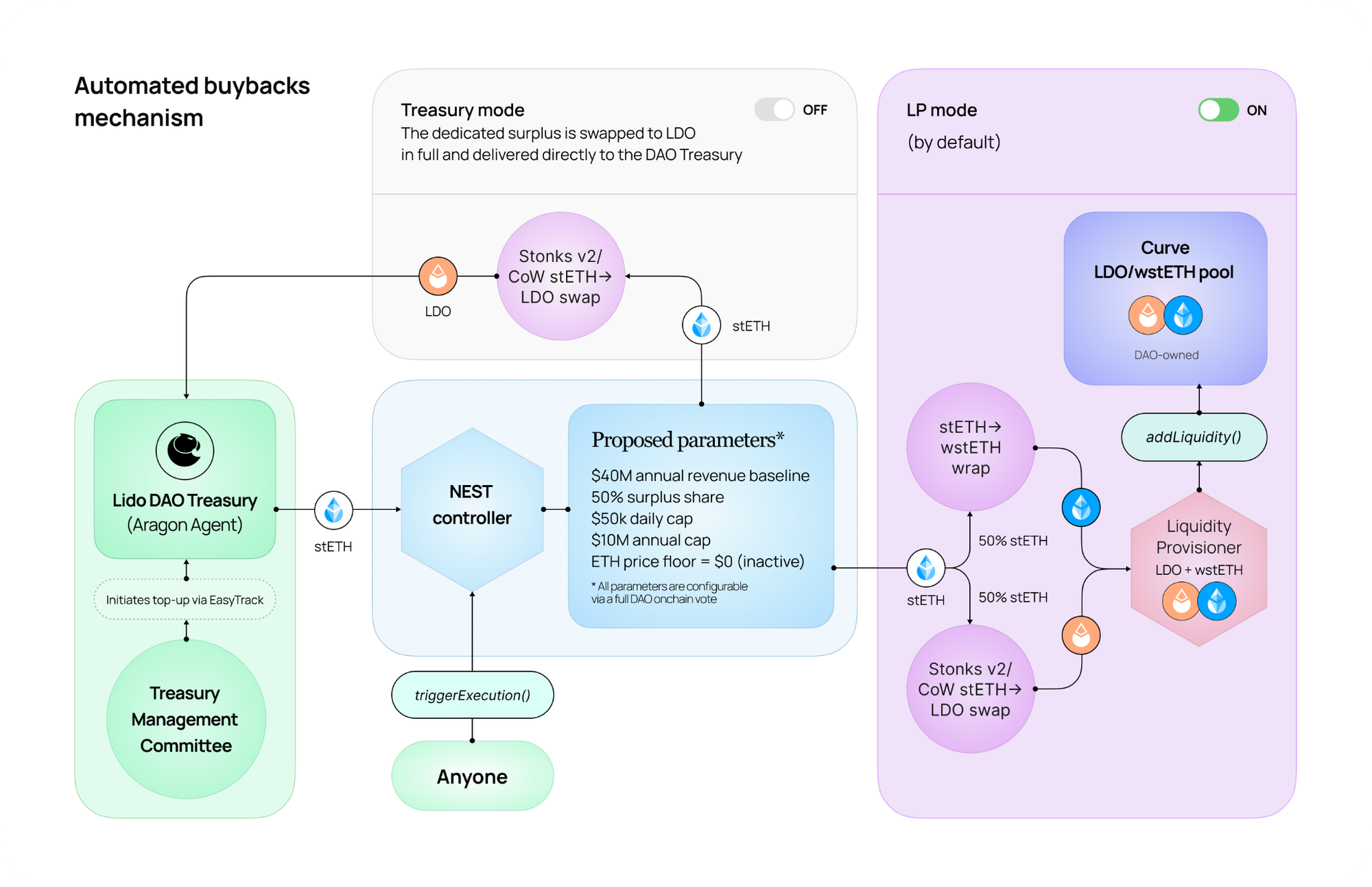
NEST has two modes: LP and Treasury. In LP mode (the proposed launch configuration), LDO is paired with wstETH and deployed as DAO-owned liquidity in a Curve v2 NG pool. In Treasury mode, LDO goes directly to the DAO treasury. Switching between modes requires an onchain vote.
With the NEST design approved, the next step is deploying the mechanism onchain. This requires a DAO Aragon vote, tentatively expected to take place in July.
The LDO Accumulation Program continues executing in parallel unless the DAO pauses its Easy Track motions.
Market State
The Ethereum staking landscape could be viewed across five primary segments:
- Simple liquid staking — traditional liquid staking without added layers or leverage (e.g., stETH by Lido protocol, rETH by Rocket Pool). Users deposit ETH and receive a liquid staking token in return.
- Exchange staking — staking through centralized exchanges such as Binance, Coinbase, or Kraken. These custodial products keep users’ ETH offchain, meaning it generally can’t be utilized in DeFi.
- Delegated staking — delegated or self-staking, typically preferred by institutional stakers, custodians, and funds. This generally involves larger deposits, lower staking rewards, and illiquidity, as ETH is locked in staking.
- APR Maxis — high-complexity strategies like restaking and leveraged staking that aim to amplify rewards through additional mechanisms (e.g., Ether.fi, StakeWise).
- Other/uncategorized — smaller or unidentified setups, such as bespoke institutional products or non-pooled staking.
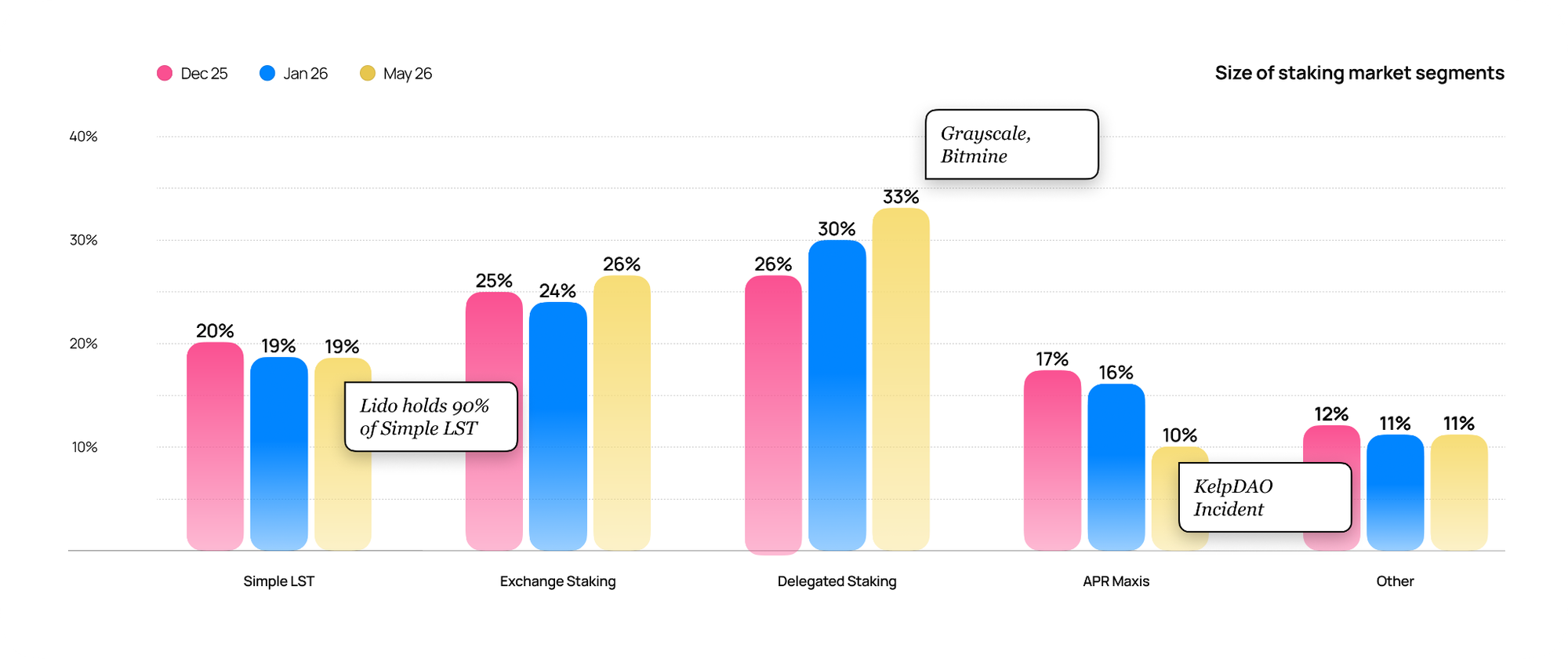
The Ethereum staking market has shifted significantly since the start of the year, with the largest shifts in May.
The biggest move was in Delegated Staking, which grew sharply on institutional inflows from Grayscale and BitMine, each contributing significant ETH staked through a handful of node operators.
By contrast, APR Maxis contracted sharply on two compounding pressures: EigenLayer reducing its restaking incentives, and the April Kelp DAO incident, which triggered widespread unwinding of leveraged staking loops across DeFi. The Lido protocol felt this too, but far less than peers: its total TVL fell only about 5%, much of it that same leveraged unwinding rather than broad user outflow.
Simple LST, Exchange Staking, and Other categories were largely stable through the period; the Lido protocol continues to hold approximately 90% of the Simple LST segment.
Lido Protocol: Share by Segment
APR Maxis
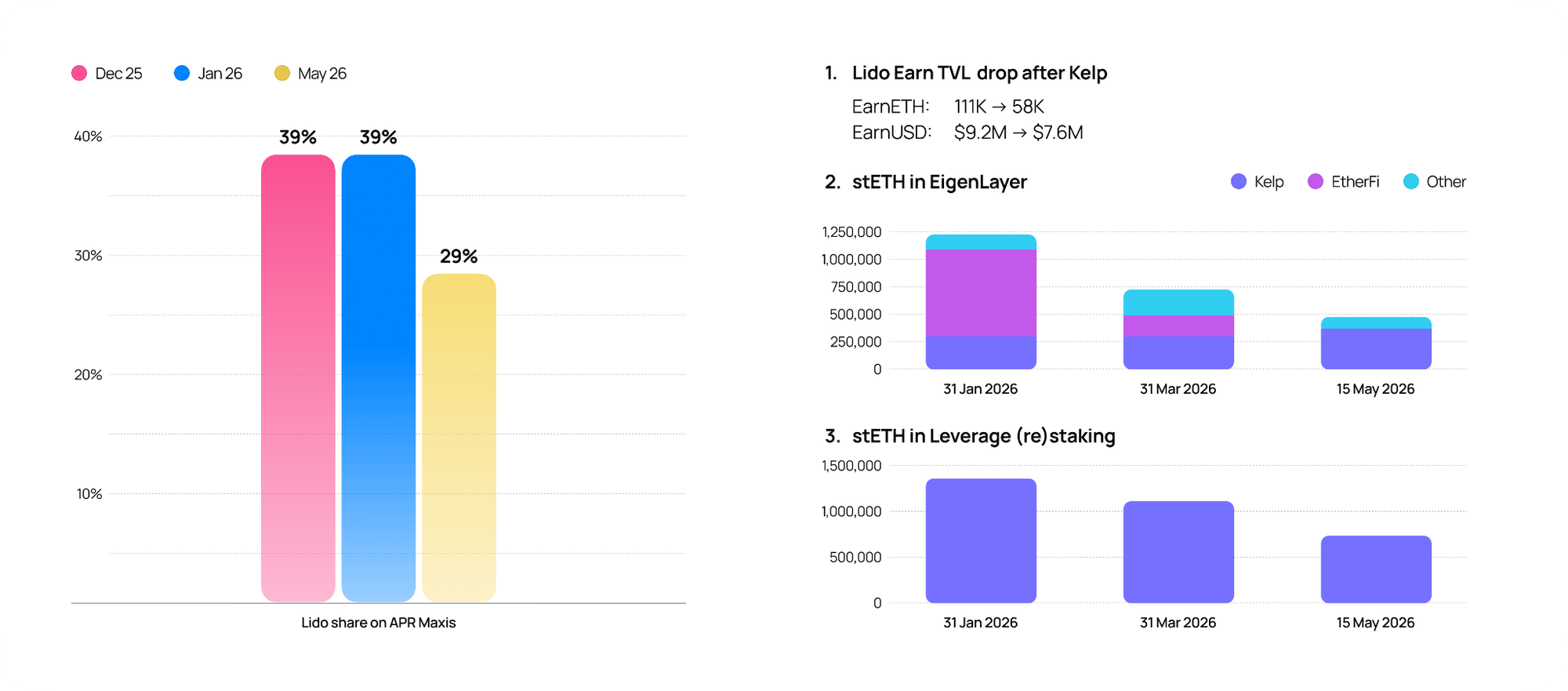
The Lido protocol’s share within the APR Maxis segment fell from 39% in December to 29% in May. The drivers:
- EarnETH TVL dropped from 111,000 ETH to 58,000 ETH following the Kelp incident; EarnUSD TVL fell from $9.2M to $7.6M.
- stETH deposited in EigenLayer declined materially as Ether.fi unwound its position.
- stETH in leveraged (re)staking strategies fell across the board.
Delegated Staking
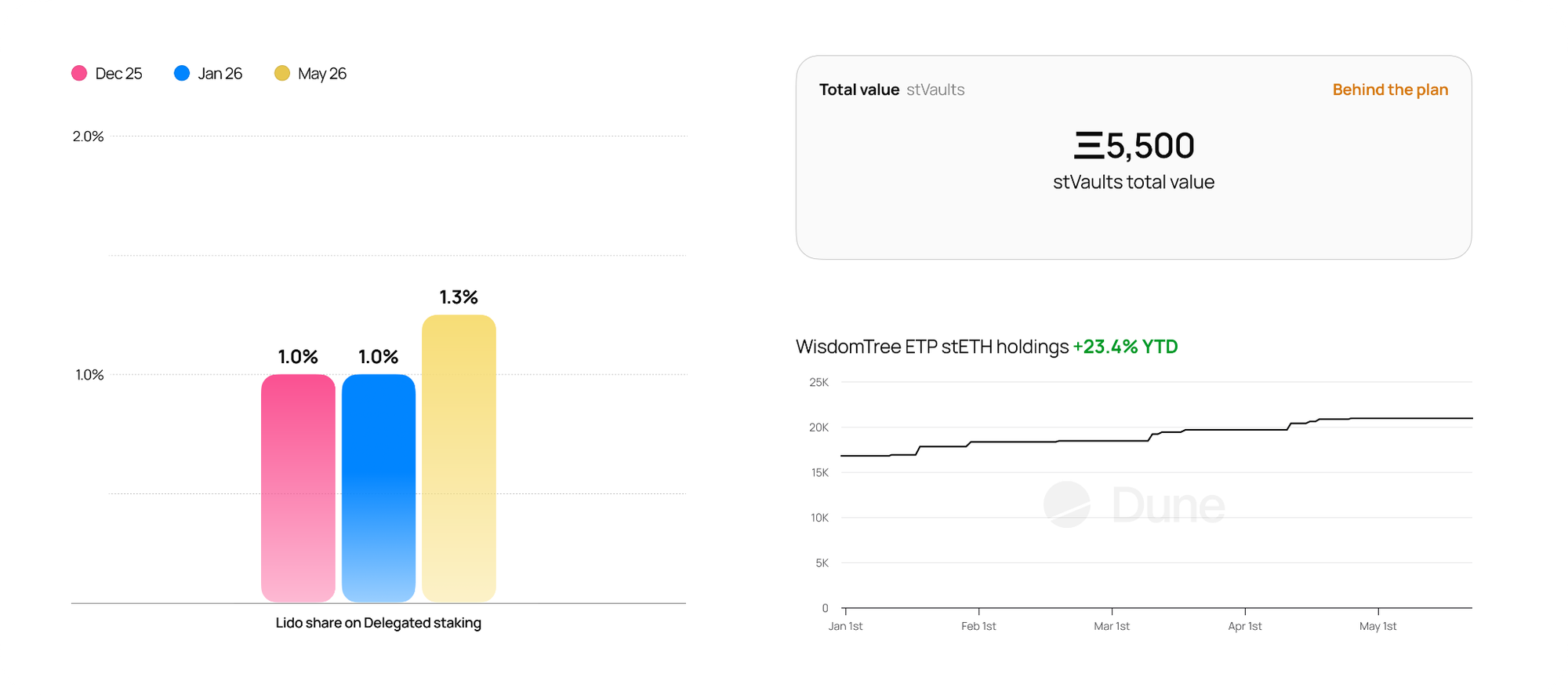
The Lido protocol’s share in the delegated staking segment moved from 1.0% in December to 1.3% in May, a slight improvement but below plan. stVaults TVL stands at approximately 5,500 ETH against a 1.05M ETH annual target.
WisdomTree’s stETH ETP holdings grew approximately 23.4% year-to-date (from roughly 17,000 to roughly 21,000 ETH), a positive directional signal.
The institutional players currently entering staking prefer the simplest available path of native staking. Two factors are slowing stVaults uptake:
- Practically, the Ethereum entry queue is congested with BitMine and ETF-related inflows, leaving institutional capital queued ahead of products like stVaults.
- Institutional appetite for advanced DeFi strategies is still building, and the recent wave of hacks across DeFi has made these players more apprehensive.
Meaningful stVaults adoption is expected from Q4 2026 onward.
2026 Targets Reassessment
The annual targets set in December 2025 are no longer achievable.
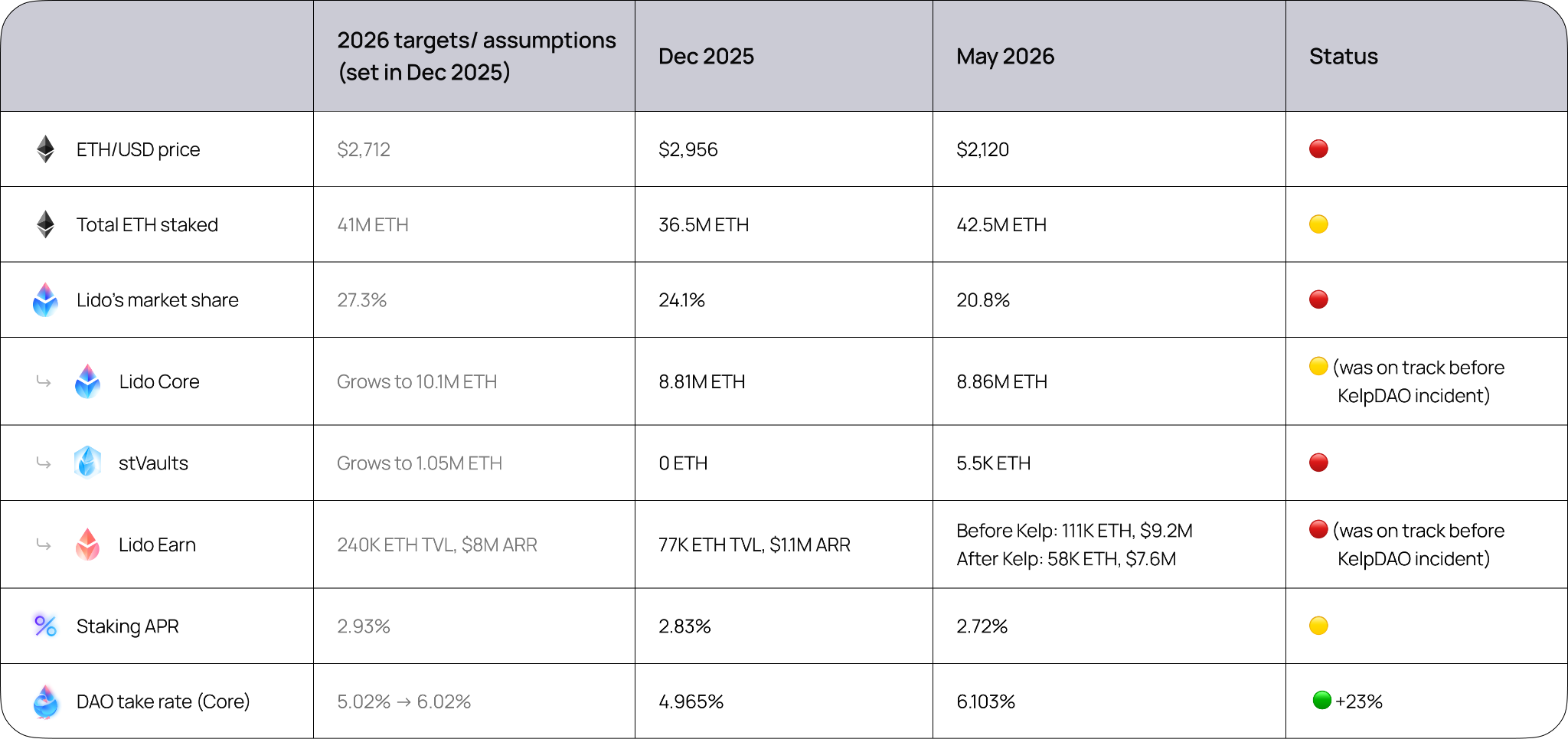
The DAO take rate hit an all-time high of 6.10% in May (4.96% in December, +23%), following the Curated Module fee adjustment proposal. The other deviations from plan are largely influenced by external market and ecosystem conditions: ETH price decline, network-wide APR compression, Ethereum entry queue of 50+ days, and the Kelp incident's contagion effects on Lido Earn and Lido Core TVL.
The Path Forward
Given current conditions, two priorities guide the near term:
- Keep staking sustainable and reduce spending on staking goals that are out of reach at current market parameters.
- Explore and build new products that leverage the Lido protocol’s established staking infrastructure and security track record. Prototype and ideation work is underway in the DeFi area.
Lido Protocol Security Stance
Security is being repriced across DeFi. This creates pressure in segments exposed to protocol complexity and validates Lido protocol’s position in simpler staking.
Third parties are signaling their preference through product decisions: on SparkLend, high-leverage ETH borrowing in e-mode accepts only wstETH as collateral.
Risk mitigation is central to Lido protocol design and development. As a result: no staking user funds have ever been lost since the launch in 2020, and the protocol holds top-tier ratings (Grade A or A+) across major third-party security and risk assessments.
- Web3SOC Grade A: assessed across operational, financial, security, and regulatory dimensions for institutional audiences.
- Credora A+ rating: covering token structure, audit history, governance architecture, and risk modifiers.
- StakingRewards A+ rating: provider risk assessed across Business, Operations, Reliability, and Security.
The security architecture operates across seven sequential layers: Spec and Research, Development, Audits, Release, Voting, Post-release, and Incident Response.
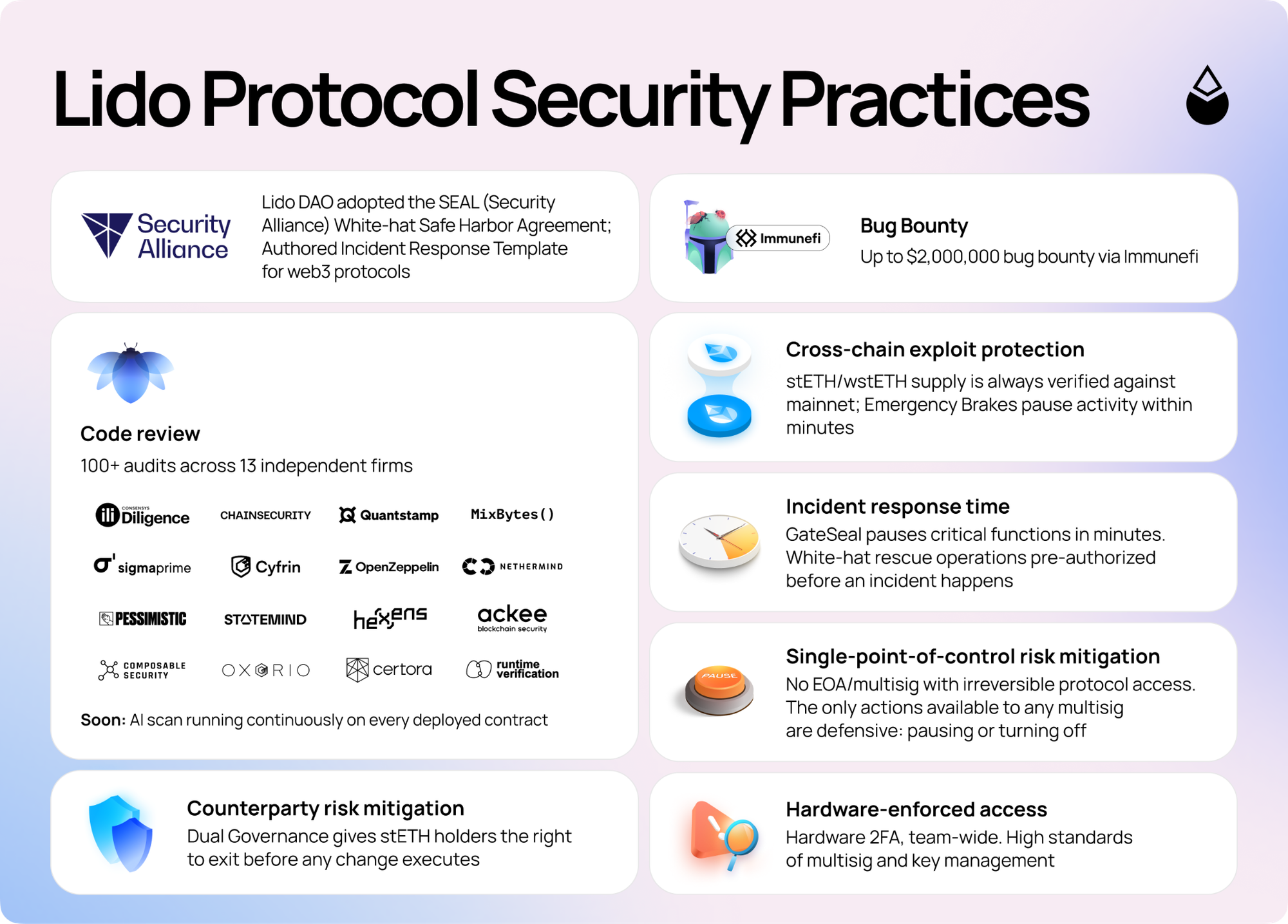
Most failures across the industry trace back to the human layer, not code. Lido contributors' approach is to limit what any individual can do, and to rely on automated circuit breakers to contain the damage from a compromised person, so that no single failure causes catastrophic loss. Multisig signing thresholds scale with the value and access of each wallet, and the DAO retains ultimate control. Even multisigs with protocol roles can only take defensive actions like pausing or turning contracts off, never resuming or changing them on their own. Pauses are time-limited, and any substantive protocol change requires a full onchain vote.
Composability
The Kelp incident highlighted how composability can expose even a well-secured protocol to others' mistakes. The approach to owning more of the stack is case-by-case, guided by three criteria:
- Best-in-industry quality. If a component benefits from market competition keeping quality high, source it externally. The competitive dynamic does the work over time.
- Misalignment risk. If reliance on a third-party operator introduces meaningful risk, and the relevant function is feasible to support internally, that function may be transitioned into the organization’s infrastructure.
- Commercial terms. Some parts of the stack are simply much cheaper to procure externally than to keep inside.
Lido DAO: New Bets
Strategic Direction
In addition to keeping staking sustainable while tightening costs, the goal is to explore new products that leverage Lido protocol’s brand in security to create new revenue sources for the DAO. Several concepts are in prototype and ideation; more will be shared as customer validation progresses.
Wisp: Confidential AI
The first product to reach public preview is Wisp, an AI harness utilizing confidential LLMs that runs prompts inside an attested hardware-sealed TEE; identity, all files and stored memory stay on the user’s machine.
Wisp follows a familiar pattern in the Lido ecosystem: contributors built a solution tailored to their operational needs after existing AI tools raised concerns about privacy and handling of sensitive information. The project is now being explored for broader external use cases.
A public waitlist is open at usewisp.io.
What’s Next
Additional DeFi products are being prototyped to leverage Lido protocol’s established security track record and generate new revenue sources for the DAO. Earlier-stage concepts aren't being discussed publicly until they've been validated.
Additional Resources
- Full recording (YouTube link will be added after publication)
- NEST buyback proposal on Snapshot and original research forum thread
- EarnETH postmortem (link will be added after publication)
- Aragon Token Ownership Index: Lido score
- Wisp Waitlist
Lido Poolside community calls run monthly. Tokenholder Update sessions are quarterly. Subscribe via Luma for updates on upcoming events.
This material is for informational purposes only and is not investment, legal, business, financial, or tax advice.
No representation or warranty, express or implied, is made as to its accuracy, completeness, or timeliness. No information in this material should be interpreted as a recommendation or relied upon as a guarantee of any specific outcome. Past performance is not indicative of future results. Any opinions or forward-looking statements reflect the current judgment of the Foundations as of the date of this publication and are subject to change without notice. Parties should conduct their own independent evaluation before making any decisions.