Lido Poolside Recap: Tokenholder Update, August 2026
The August 2026 Lido Poolside Tokenholder Update covered Lido DAO’s H1 2026 financials, product updates across staking, Lido Earn and Wisp, staking market conditions and the EIP-8363 issuance discussion.
Read the highlights below or watch the recording. The Lido DAO H1 2026 report is also available.
Agenda
- Financials
- Product Updates
- Issuance (EIP-8363)
- Next Steps
Key Points
- Lido DAO recorded a $1.6M operating surplus in H1 before non-recurring items, and a $4.45M loss after the Kelp-related one-off expense.
- The treasury closed H1 at $88.3M, down from $157.5M. $60.9M of the decline is attributable to the ETH price, which closed the period at $1,569. As of 25 August, with ETH at $2,441, it stood at $121.3M. lido.fi/ldo-hub/reports/h1-2026
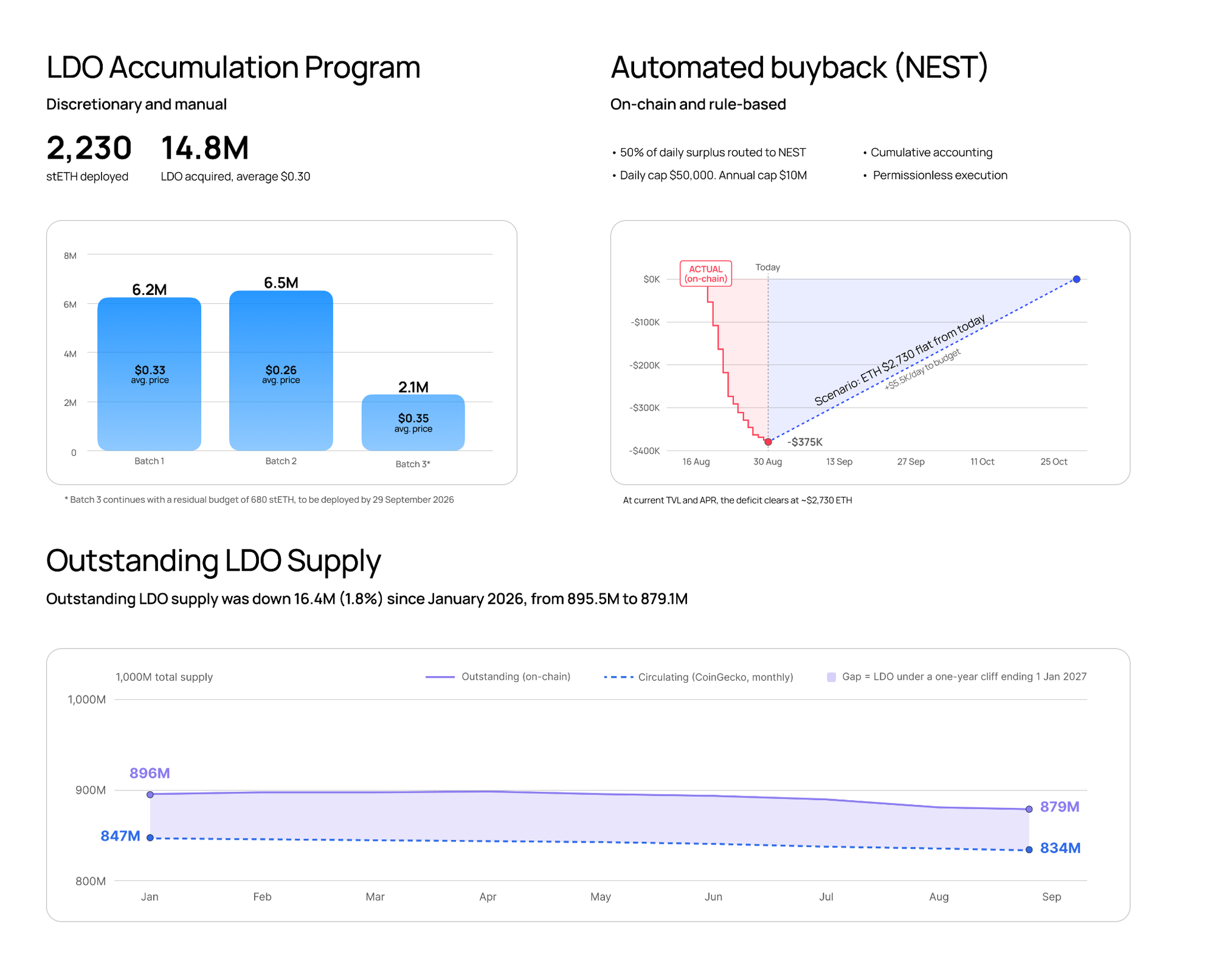
- The LDO Accumulation Program deployed 2,320 stETH, returning 14.8M LDO to the treasury, and the NEST automated buyback went live. Outstanding LDO supply fell for the first time, down 16.4M or 1.8% since January.
- Lido Earn is recovering from the April Kelp incident. EarnETH TVL is up to 77.9k ETH and EarnUSD reached $36.8M as of 31 July.
- Wisp, Lido DAO’s privacy-first AI harness, launched in August with the free tier open. It currently has 200 users, with a 5% conversion rate to subscription.
- Actively discussed, EIP-8363 proposes a modification to the ETH issuance curve that would materially affect Lido. As the Lido Foundations have been working towards both a leaner protocol and revenue beyond staking for the past year, Lido is ready for the full range of outcomes of the proposal, including a low-issuance regime.
Introduction
Lido Protocol Fundamentals
Lido is the leading liquid staking protocol on Ethereum. Alongside a simple and secure way to stake ETH, the Lido ecosystem offers modular infrastructure for custom staking setups via stVaults, DeFi-native yield strategies through EarnETH and EarnUSD, and Wisp, a privacy-first AI harness, among other new bets to be announced by the end of the year.
The Lido protocol is governed by Lido DAO, a decentralized autonomous organization of LDO tokenholders. Through the governance process, tokenholders set parameters, approve upgrades to the Lido protocol, manage Lido DAO Treasury allocations, define goals, and authorize grants for the Lido Labs, Lido Ecosystem, and Lido Alliance Foundations (together, the “Foundations”).
The Foundations are DAO-adjacent entities whose purposes are directed toward supporting the Lido DAO ecosystem, with material actions requiring LDO tokenholders’ approval as per the Foundations’ bylaws.
All protocol fees flow to the Lido DAO Treasury, and product-line revenue from Earn and Wisp reaches the DAO as surplus, after covering expenses approved through the annual Ecosystem Grant (EGG).
Lido Protocol: Operational Model
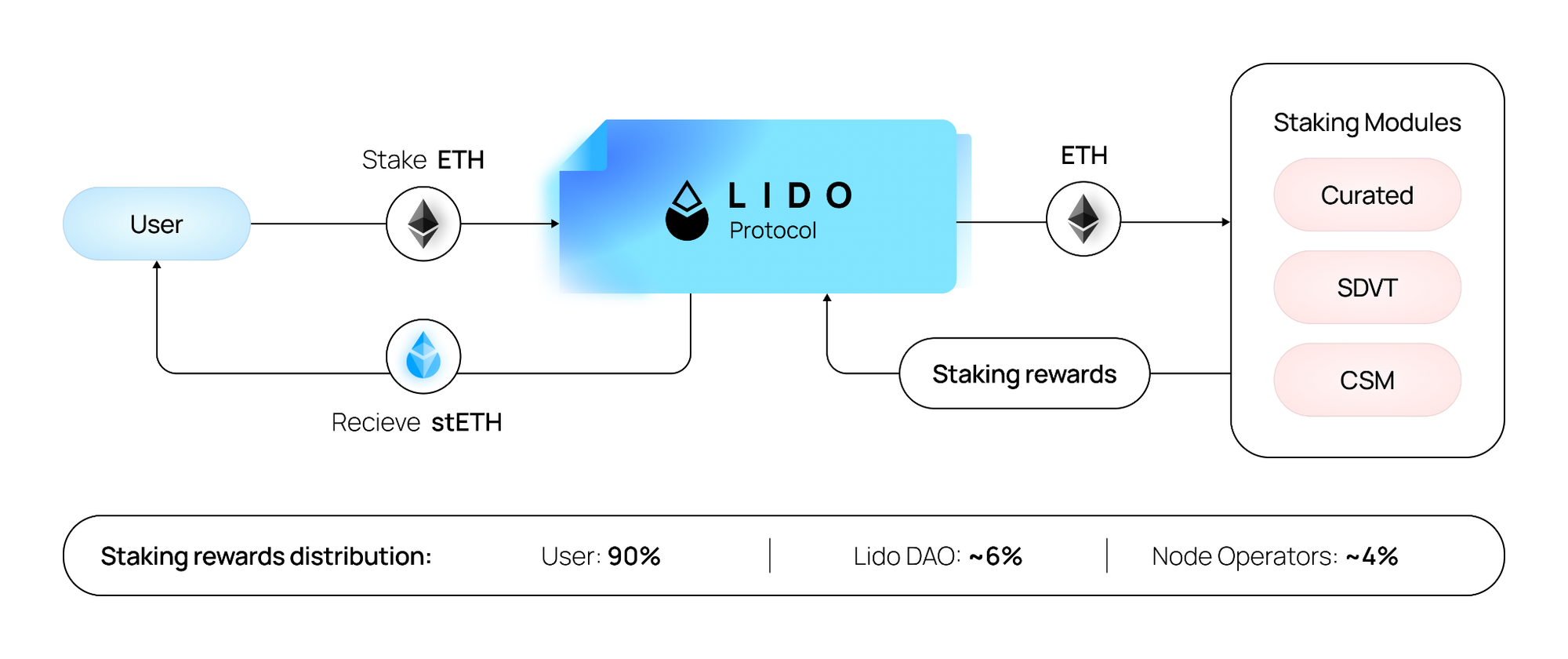
The Lido protocol’s core operational model remains unchanged. Users deposit ETH into the Lido protocol and receive stETH (staked ETH) in return, a liquid token that can be utilized across the broad DeFi ecosystem.
ETH is allocated through the Staking Router into various Staking Modules.
Ethereum staking rewards flow back to the Lido protocol, with 90% distributed to stakers, approximately 4% (depending on the Staking Module) allocated to Node Operators, and the remainder directed to the Lido DAO Treasury (the “Treasury”).
Financials
H1 Financials & Operating Results
The DAO closed H1 2026 with a positive operating result before non-recurring items, despite ETH falling 47% over the period—from $2,969 on 1 January to $1,569 on 30 June. The result reflected continued revenue strength alongside more conservative spending than planned.
- Total net DAO revenue was $15.9M, compared with $14.3M in Foundations’ expenses.
- Operations generated a $1.6M surplus before the one-off $6.1M Kelp incident expense, which brought the total result to a $4.5M loss.
- Full-year Foundations’ spending is projected at approximately $37.7M, below the $41M baseline annual grant request and the roughly $60M total including discretionary funding.
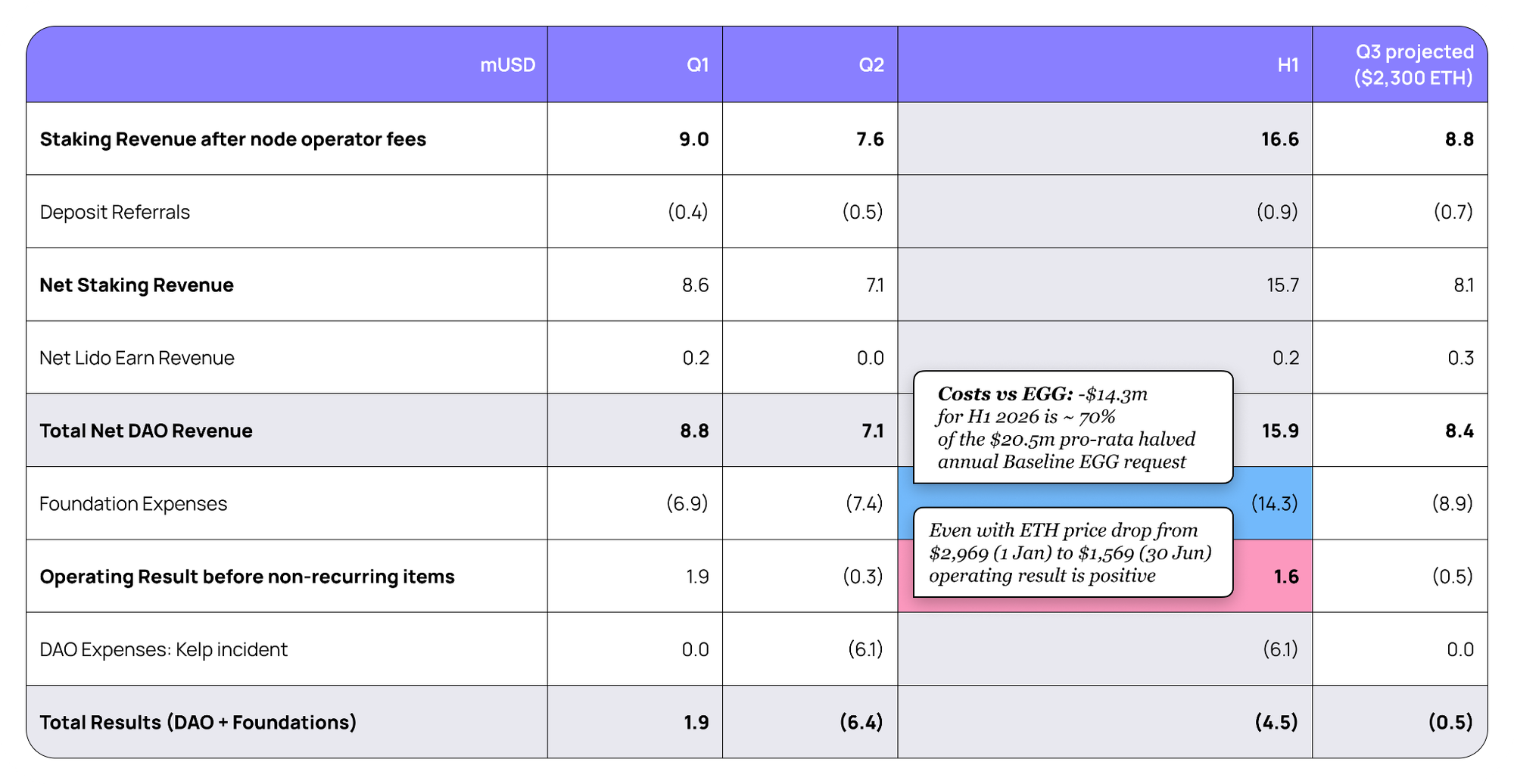
Staking generated a $6.73M operating result after all operational expenses, on $15.7M in revenue, despite the low ETH/USD price.
More details: lido.fi/ldo-hub/reports/h1-2026
Treasury Position
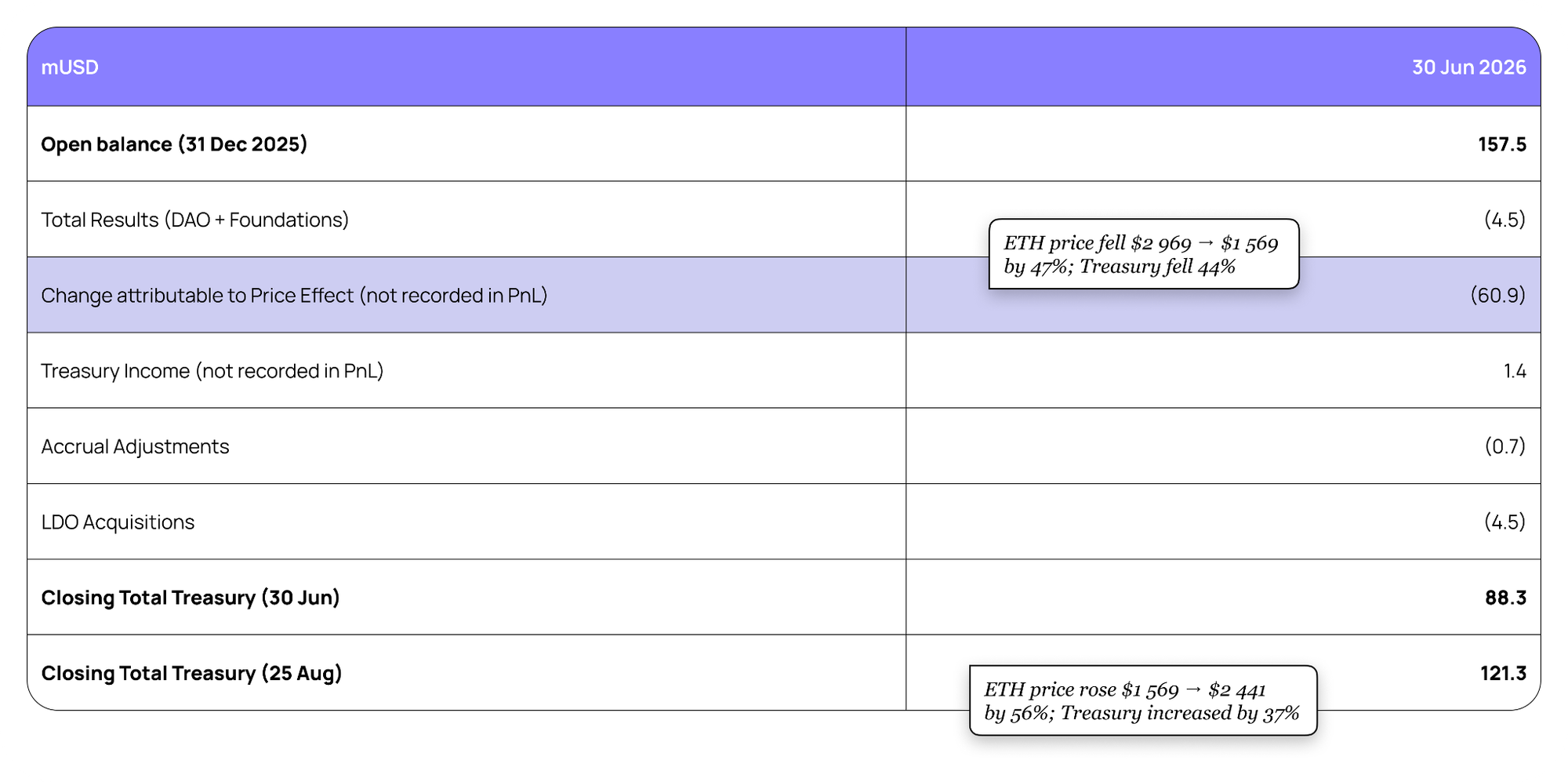
- The Treasury position excluding LDO decreased 44%, from $157.5M to $88.3M, valued at the 30 June closing ETH price of $1,569.
- Of the $69.2M reduction, $60.9M reflects the ETH price decline and $4.5M was allocated to LDO acquisitions. The remainder reflects the negative H1 result and other accrual movements.
- As of 25 August, with ETH at $2,441, the Treasury was ~$121.3M, up 38%.
LDO Supply
- Outstanding LDO supply was down 16.4M (1.8%) since January, from 895.5M to 879.1M.
- The LDO Accumulation Program deployed 2,320 stETH, returning 14.8M LDO to the Treasury at an average price of $0.30.
- NEST, the automated buyback mechanism, was enacted in August. It programmatically buys LDO using a portion of the daily surplus when the set parameters are met. The balance works in a cumulative manner, accruing a deficit when revenue sits below the operating baseline. That is currently the case, so the deficit keeps accruing and the mechanism has not been triggered yet.
Product Updates
Staking Market Segments
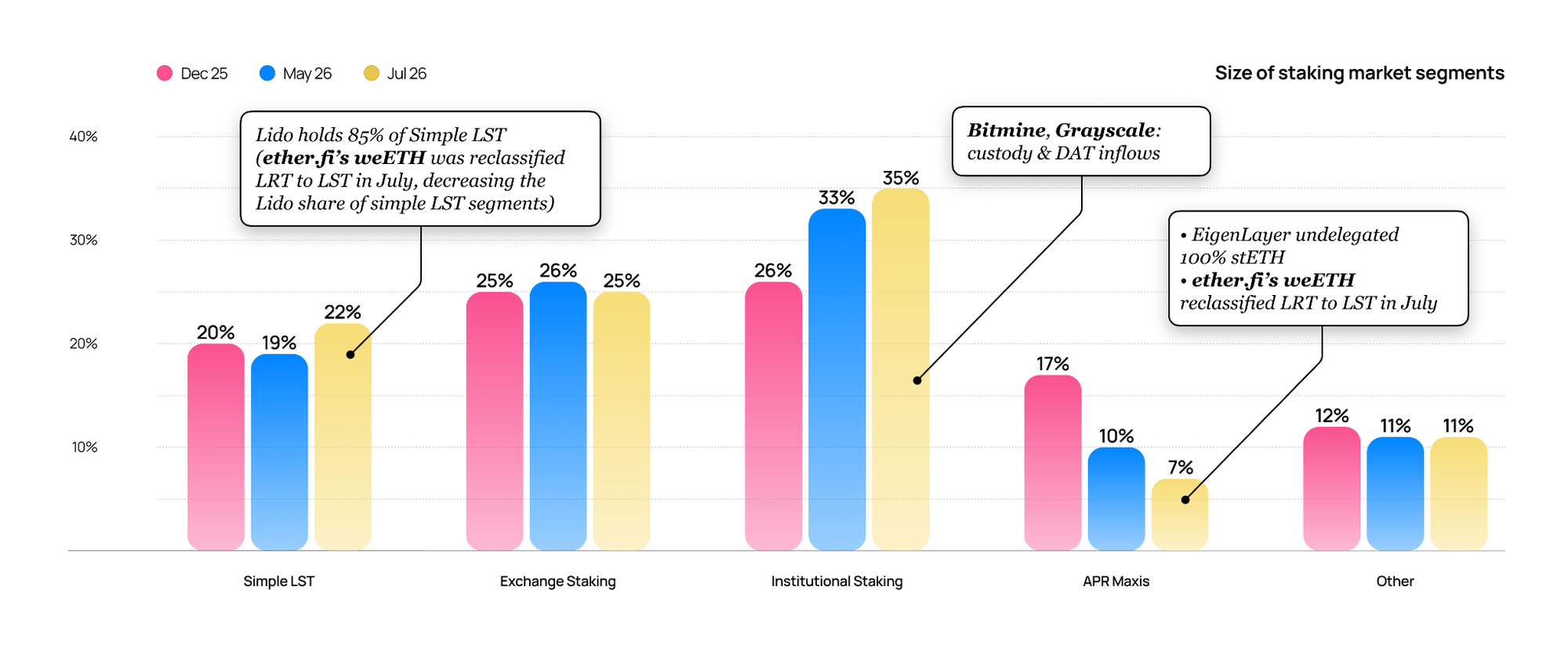
- Institutional staking continued to expand, driven by custody and digital asset treasury inflows from BitMine and Grayscale.
- The APR Maxis segment share fell from 17% to 6.5% in the DeFi drawdown triggered by the Kelp incident, as leveraged positions were closed and capital left the highest-risk staking segments. EigenLayer restaking also contracted, with capital migrating away from restaking: EigenLayer's stETH deposits were undelegated and ether.fi shifted from restaking to liquid staking, with a significant portion of that capital moving to simple LST holdings.
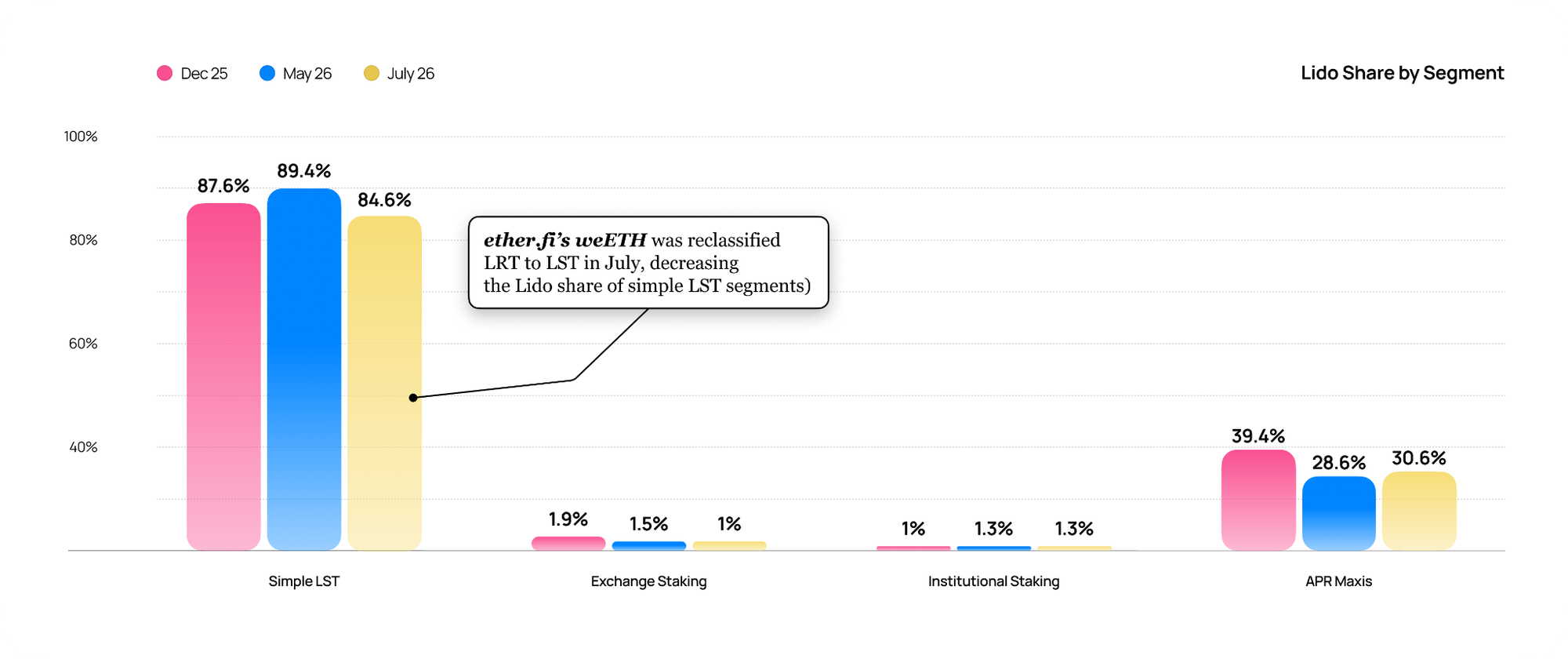
- Lido’s lower share of Simple LSTs reflects that reclassification of weETH, which expanded the segment. Lido’s ETH TVL remained above its year-start level, although growth continued to lag the wider staking market.
Lido Protocol: Share by Segment
Lido holds the large majority of simple liquid staking and a meaningful position among APR Maxis. Exchange and institutional staking are where the room to grow sits.
Lido Core: DAO Take Rate
The DAO take rate has moved from 4.97% in December to 6.11% across January to July, 6.18% for July to August, and an expected 6.25% in September. Three changes drove it:
- Curated Module fee change. Three categories of Curated Node Operators replaced a flat 5% for all: Standard at 3.50%, Extra Effort at 4.00% and Client-Team at 4.50%.
- Simple DVT regular clusters wind-down. Regular clusters at a 2% DAO fee were wound down. Super Clusters at a 4% DAO fee continue to run validators.
- Curated Module v2 upgrade. On-chain node operator types with a 4% maximum fee: Default at 3.5%, and Extra Effort, Decentralization and Public Good at 4.0%.
Looking ahead, the 0x02 CSM mainnet release is expected in October 2026 at a 2% node operator fee, and the ValMart mainnet release in Q2 2027 will enable fee competition in the Curated Module, which can drive the take rate up further.
Institutional Staking
- ETPs. WisdomTree holds 23.1k ETH, up 36% in ETH terms, in Europe's first fully-stacked ETH ETP. Its stETH holdings went from 17.0k on 1 January to 21.0k on 30 June and 23.1k on 14 August. VanEck has filed for a staked ETH ETF in the US, which is under discussion.
- Custody. The Anchorage Digital integration is live, making it the first federally chartered US bank to support wstETH minting. This was one of the conditions required for the SharpLink allocation to proceed (see further details below).
- Digital asset treasury companies. SharpLink selected Lido for a $200M stETH allocation, announced on 13 August. It is committed but not yet staked.
- stVaults TVL doubled in July, from 5.8k ETH on 30 June to 11.5k on 31 July.
Lido Earn Recovery
Recovery after the LayerZero/Kelp incident is well advanced:
- New allocations drove APR higher, to roughly 6.1% on EarnUSD.
- EarnETH TVL recovered from 44k ETH to 77.9k ETH as of 31 July.
- EarnUSD grew from $7M to $36.8M as of 31 July.
- Gross revenue reached $374K as of 31 July.
Wisp: Privacy-First AI Harness
Wisp went live in August and the free tier is now open.
- Multi-model: GLM 5.2, Kimi K2.6, GPT-OSS 120B and Qwen 3.6 Uncensored on the free tier; Kimi K3 on the paid tier.
- User stats: 200 users, 5% conversion to paid users.
- Local transcripts: sensitive meeting transcripts are processed on-device via a local Whisper-based model.
- MCPs: connectors are live for Notion, Linear and Google, with full support for custom MCP connectors so users can wire in any tool they run.
What comes next: an API for programmatic access to private inference and the harness; a Windows sandbox and desktop client for Windows 11 and above; native mobile apps; cloud and shared workspaces following B2B discussions; and a workflow marketplace of pre-built automations for accounting, operations, and legal.
Wisp is available for Linux and macOS at usewisp.io, and the team posts at @usewisp_io.
Issuance Debate (EIP-8363)
A long-running debate about Ethereum staking issuance has led to the EIP-8363: "Tapered Issuance Burn" proposal to taper validator rewards toward zero as the staked share approaches 50% of ETH supply (currently a little over 34%). On August 4, 48 hours before the deadline, it was proposed for inclusion in the Hegota upgrade.This proposal could materially affect Lido’s future by compressing staking rewards across the market.
Lido contributors have been actively participating in the discussion and maintaining a consistent position. They are not opposed to issuance changes, but are concerned about moving toward concrete monetary-policy proposals before the consequences for Ethereum’s security and operator economics have been sufficiently explored. A consolidated position on EIP-8363 was published here.
EIP-8363 does not introduce a new risk. It's one that has been considered for a long time. Lido's staking revenue in dollar equivalent depends on three variables: ETH price, issuance, and market share. In H1 2026, ETH fell 47%, yet staking operations still closed both quarters in surplus, with a $6.7M product-level result. The current protocol roadmap and revenue projections also assume said variables will remain volatile.
Because ETH price, issuance, and market share remain outside Lido’s control, the DAO has been working on reducing exposure to these variables for some time, well before EIP-8363. The work is two fold: running the protocol leaner, and growing revenue beyond staking.
- A leaner protocol. Under lower issuance, Lido staking protocol can still generate a surplus, but it has to become a leaner product: lower operating costs, a smaller curated set, and a stronger emphasis on cost over diversity.
The core measures remain the same:
- Cut operating costs
- Improve DAO take rate: The DAO's share of staking rewards rose from 4.96% in December 2025 to 6.15% at the end of H1 2026. The Lido Core upgrade, released in July, paves the way for a considerably smaller cost base for the core staking protocol and better unit economics through operator fee competition, which ValMart will enable in 2027.
- Consider a protocol fee increase as a last resort (contested via Dual Governance).
- Revenue beyond staking. Lido Earn, Wisp, and other bets aim to generate non-staking revenue. Lido Labs Foundation is working on two products for non-ETH low-risk DeFi.
Next Steps
Scorecard: H1 vs 2026 Targets
Targets set in December 2025 were revised mid-year. Beyond the scored targets, Lido continues to drive down the cost of running staking.
Two New Products
Lido Labs is working on two products for non-ETH low-risk DeFi.
Q&A Highlights
Kelp cost the DAO $6 million. What's actually different in risk management now?
- Due diligence is more involved and largely automated.
- A new fact sheet format for strategies, ongoing position monitoring, smaller test allocations, and external risk factor monitoring.
- Where an opportunity is attractive but raises concerns, the approach is now to address the underlying issue, for example, the timelock situation at Pendle.
Q3 is projected to be negative. What ETH price is needed to break even, and what’s the plan if it stays below that for another year?
- Closing full-year 2026 at zero requires an average ETH price of about $2,850 in H2, because H2 must absorb the H1 loss as well as break even on its own.
- Breaking even on a steady basis at today’s cost base requires about $2,500. That is the more relevant number beyond this year.
- Staking itself generated a positive operating result in both quarters, even with ETH down almost 50%.
- The plan is a growth plan rather than a rescue plan: spending goes to products that strengthen the ecosystem and can earn on their own, less dependent on ETH price or issuance.
It was mentioned that spending was reduced. How much did that save, and what was the trade-off?
- Spending came down three ways: below the budget for this year, below internal forecasts, and below last year.
- The expected savings are about $3.3M against the baseline budget, and more against the request as a whole.
- Little was given up in the short and medium term. The savings came from spending less on partnerships and integrations without a clear return, dropping hiring plans for roles no longer expected to be filled, several lines coming in well under plan, and deferring some swaps and spending into H2 to catch a better price.
How did Lido fare during the fall of restaking?
- stETH had a coopetition relationship with restaking protocols: LRTs competed with stETH as an LST, while stETH could serve as collateral within EigenLayer and within certain LRTs.
- The immediate effect of the April LayerZero/Kelp incident was that staking TVL fell drastically on both the LRT and LST side, as loop positions unwound and participants took a more risk-averse approach.
- Most LRT protocols continued to dwindle in TVL, whereas Lido's TVL regained its level from the beginning of the year and surpassed it, hitting the year's peak in August.
- Two things drove that: a flight to safety after the hack, and restaking showing there are very few real yield sources. EigenLayer recently voted to turn off EIGEN incentives for most LRTs and for stETH deposited to EigenLayer, so the subsidized yield behind that momentum went away.
- As yield heavily subsidized by token issuance dries up, users are expected to come back to stETH for its utility in DeFi and its overall risk profile.
What's Next
The September Lido Poolside call will feature Joseph Lubin, founder of Consensys and chairman of SharpLink, and Joseph Chalom, CEO of SharpLink, on the $200M SharpLink ETH staking allocation going through Lido.
Add it to your calendar and join the call on September 17,
Additional Resources
- Full recording
- Lido DAO H1 2026 report
- Forum thread for this call
- EIP-8363: Tapered Issuance Burn and the Lido contributors' consolidated view
- Kelp Incident Review: EarnETH Exposure, Response, and Risk Framework Changes
- NEST: Liquid Buybacks forum thread
- LDO Accumulation Program forum thread
- Aragon Token Ownership Index: Lido score
- Wisp
Lido Poolside community calls run monthly. Tokenholder Update sessions are quarterly. Subscribe via Luma for updates on upcoming events.
This material is for informational purposes only and is not investment, legal, business, financial, or tax advice.
No representation or warranty, express or implied, is made as to its accuracy, completeness, or timeliness. No information in this material should be interpreted as a recommendation or relied upon as a guarantee of any specific outcome. Past performance is not indicative of future results. Any opinions or forward-looking statements reflect the current judgment of the Foundations as of the date of this publication and are subject to change without notice. Parties should conduct their own independent evaluation before making any decisions.