LDO Automated Buybacks: Overview
The Lido DAO operates within open strategic cycles, publicly setting goals and appointing the Lido Foundations to deliver them.
One of the key goals set for 2025 and continued in 2026 was LDO alignment: tying LDO more directly to the Lido protocol’s success.
At the core of the LDO alignment initiative sits NEST (Network Economic Support Tokenomics), an onchain mechanism that links protocol revenue to LDO acquisition, financed by DAO treasury surpluses.
This article explains the design choices behind the NEST mechanism, how it works, its launch parameters, and the security approach.
Automated Buybacks: Design Rationale
The Lido DAO builds its governance mechanisms to the highest standards of transparency, security and decentralization. Protocol upgrades pass through fully onchain votes; Dual Governance gives stETH holders built-in oversight of DAO decisions; routine treasury allocations run through optimistic Easy Track motions.
The same approach applies to LDO buybacks. Along the way, the simpler paths were weighed and rejected:
- manual monthly buybacks introduce discretionary human intervention;
- burning acquired LDO is a one-time signal, not a durable mechanism;
- a simple revenue percentage split does not enforce surplus discipline and can activate with no actual treasury surplus.
The DAO approved the technical rails and mechanism design to make buybacks transparent, permissionless, and under full DAO control.
How NEST Works
NEST is a programmatic system that uses a portion of Lido protocol revenue to acquire LDO, subject to certain thresholds and conditions specified in LIP-36. In short, when staking revenue exceeds an operating baseline, a bounded share of the surplus is converted into LDO via CoW Swap. The more the protocol earns, the more LDO is bought.
Modes of NEST
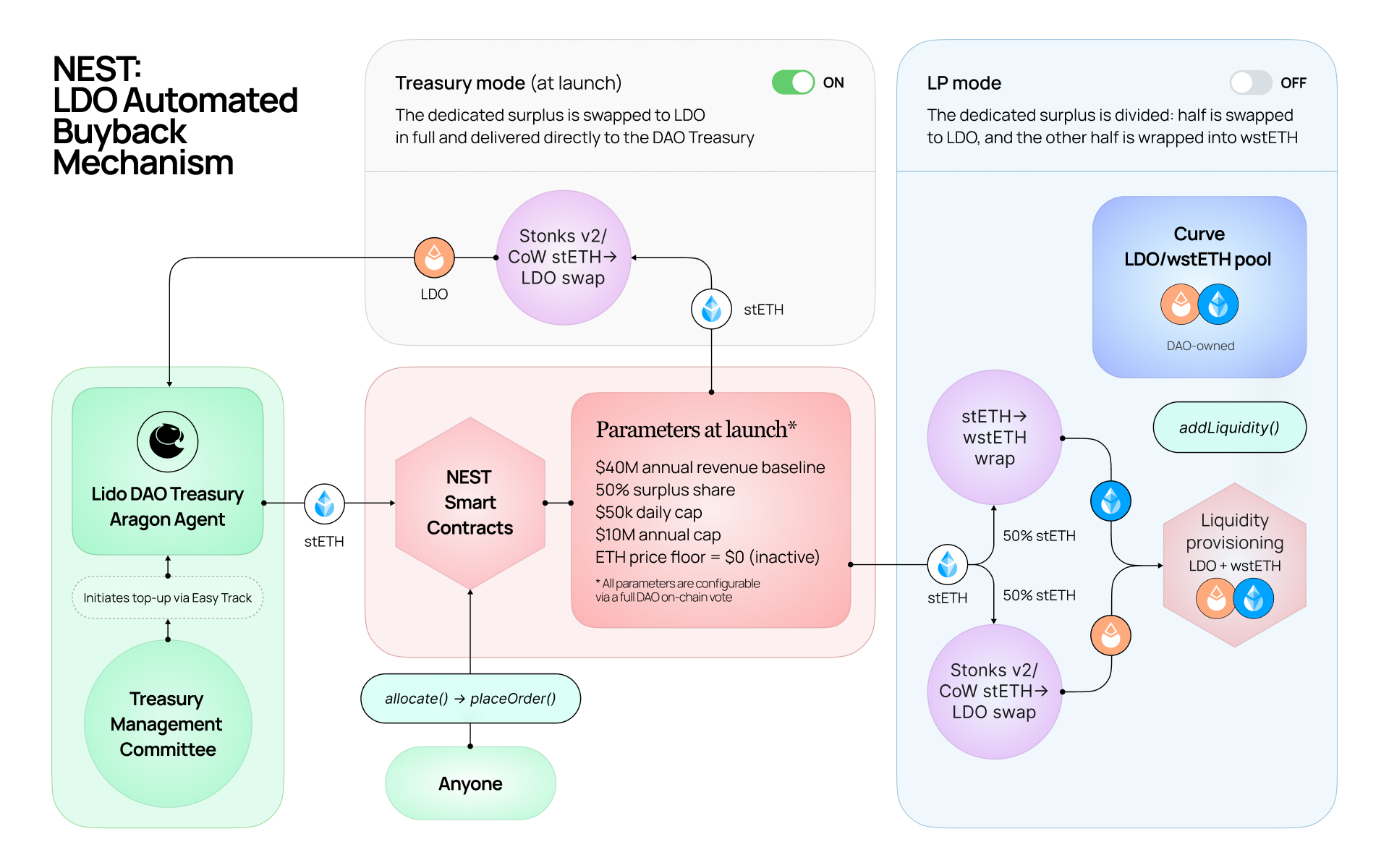
As onchain LDO liquidity is relatively shallow, NEST’s buyback mechanism is designed with two modes to optimize performance. In Treasury-only mode, the daily allocation converts to LDO in full and flows directly to the DAO treasury via an Aragon Agent contract.
In LP mode, the daily allocation is divided in two: half purchases LDO, and the other half is wrapped into wstETH. Both parts are deposited as DAO-owned liquidity into a Curve v2 NG pool, and the LP tokens remain under DAO ownership.
NEST is launched in Treasury mode, as LP mode delivers its benefits only under specific market conditions. The Curve pool is already deployed, so switching to LP mode later will only require an onchain vote.
Lido DAO Levers
The NEST mechanism is fully onchain and permissionless. The Lido DAO sets the key parameters and can change them by onchain vote.
While at launch NEST tracks Lido protocol staking revenue only, its architecture is designed to accommodate additional revenue sources through future governance votes, with Lido's expanding product line in mind.
NEST Parameters
At launch, the NEST configuration approved by the DAO is:
- Revenue baseline: $40M annualized (~$109K/day)
- Surplus share: 50% of daily surplus routed to NEST
- Daily cap: $50,000
- Annual cap: $10M (rolling 365-day ceiling)
- Pool price-drift limit: 2% on LP deposits (dormant at launch)
- Execution: daily, permissionless, via CoW Swap using Stonks v2
- Accounting: cumulative across time, not day-by-day
Each day, NEST compares the DAO's share of staking revenue against the revenue baseline. Then it adds 50% of the difference (the share set at launch) to a running NEST balance. While that balance is positive, NEST buys LDO daily within the specified caps. If the balance turns negative, purchases pause until new surplus restores it.
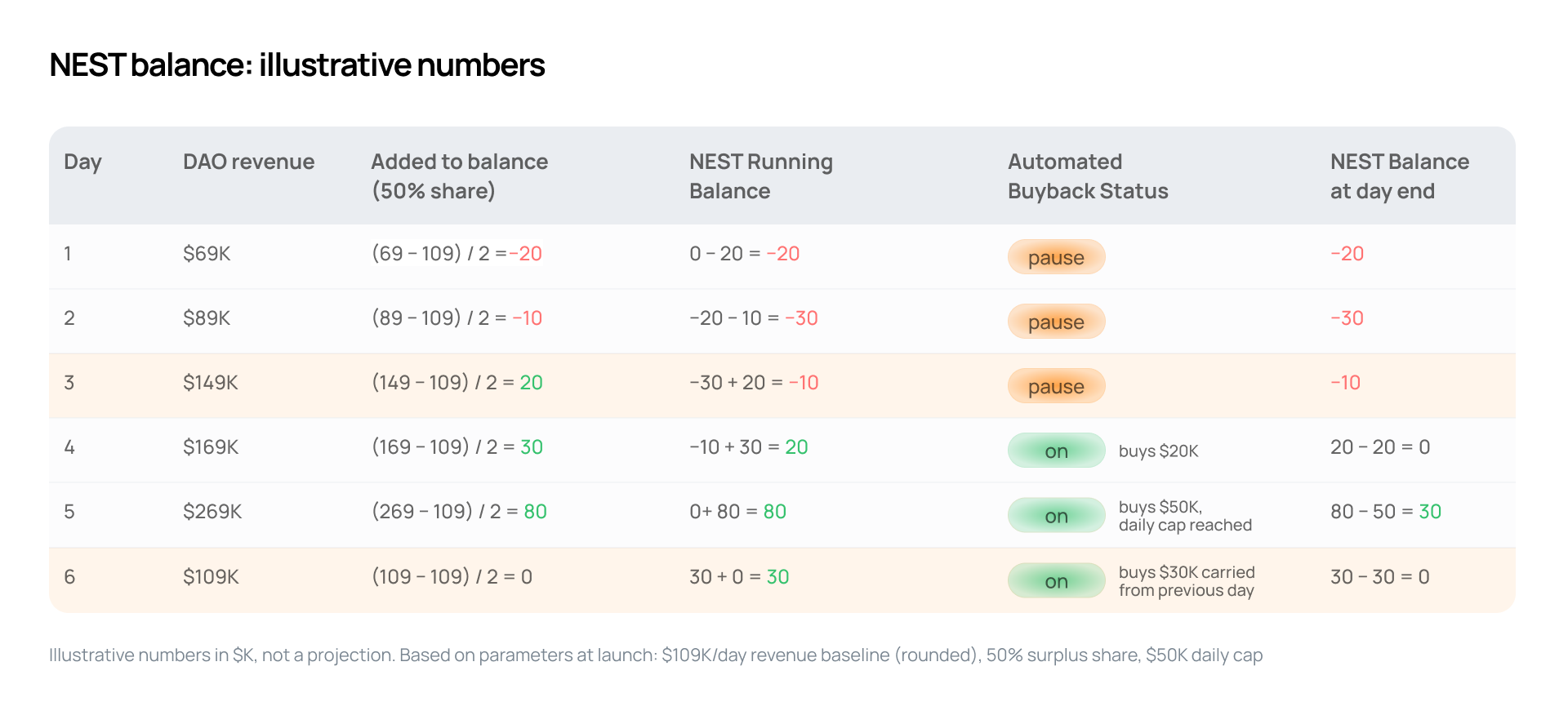
The cumulative model was chosen to prevent the two failure modes of a daily-spend approach: overspending during consecutive good days and the inability to carry forward unused capacity. The $50,000 daily cap is the primary safety guardrail, bounding exposure over a six-day governance response window to approximately $300,000.
Backtesting on 2024–2025 revenue showed the model would have delivered $7.09M, exactly its target spend, from $94.18M in total rewards.
Full calculations and the comparison against alternative designs are documented in LIP-36 and the Research forum discussion.
All parameter values are adjustable through a full DAO vote, so the DAO can tune them as protocol economics evolve.
Mitigating Risks
A programmatic mechanism that spends treasury assets daily introduces specific risks. This is how the mechanism's design addresses each:
- Discretionary error. NEST mechanisms run solely on parameters approved by DAO vote, and said parameters are the only ones that determine the buyback. Changing parameters requires a DAO vote.
- Parameter manipulation. All parameter changes (baseline, caps, surplus share, divergence tolerance, mode) require a full onchain vote. Easy Track is used only to fund the BuybackAllocator with stETH, never to modify configuration.
- Oracle, pool sandwiching, or price feed corruption. The daily cap bounds maximum exposure during a corrupted-oracle scenario to approximately $300,000 over a six-day governance response window. OracleRouter price queries can be paused independently, per token. In LP mode, a 2% price-drift limit blocks Curve deposits when the pool's internal EMA drifts from the OracleRouter reference price.
- Slashing or revenue shock. The revenue source records zero until the protocol has fully recovered, so buybacks naturally pause without governance action. There is no manual reset lever: a negative balance recovers as surplus returns. The DAO can speed that up by raising the surplus share or lowering the baseline through an onchain vote.
- Operational incidents and keeper failure. Three independent pause domains cover the system: the BuybackExecutor, Stonks order creation and settlement, and individual OracleRouter price feeds. Each can be stopped by the Emergency Brakes multisig or the Treasury Management Committee without affecting the others. Daily execution itself is permissionless, so the mechanism does not depend on any specific keeper. Asset recovery remains available at all times through an onchain DAO vote.
All NEST-purchased assets remain DAO-owned, and any movement outside the mechanism’s defined operational paths requires explicit DAO authorization.
LDO Accumulation Program Note
NEST should not be confused with the LDO Accumulation Program, a separate one-time treasury operation that the Lido DAO approved on 13 April 2026. That program is a discretionary, committee-executed initiative rather than a structural mechanism, and is unrelated to NEST in design and governance. Batch parameters, execution updates, and further detail are published on the Research forum.