Introducing 0x02 CSM: A Permissionless Path to Running Higher-Balance Validators
TLDR
- 0x02 CSM is live on csm.lido.fi, allowing anyone to run 0x02 validators through the Lido protocol.
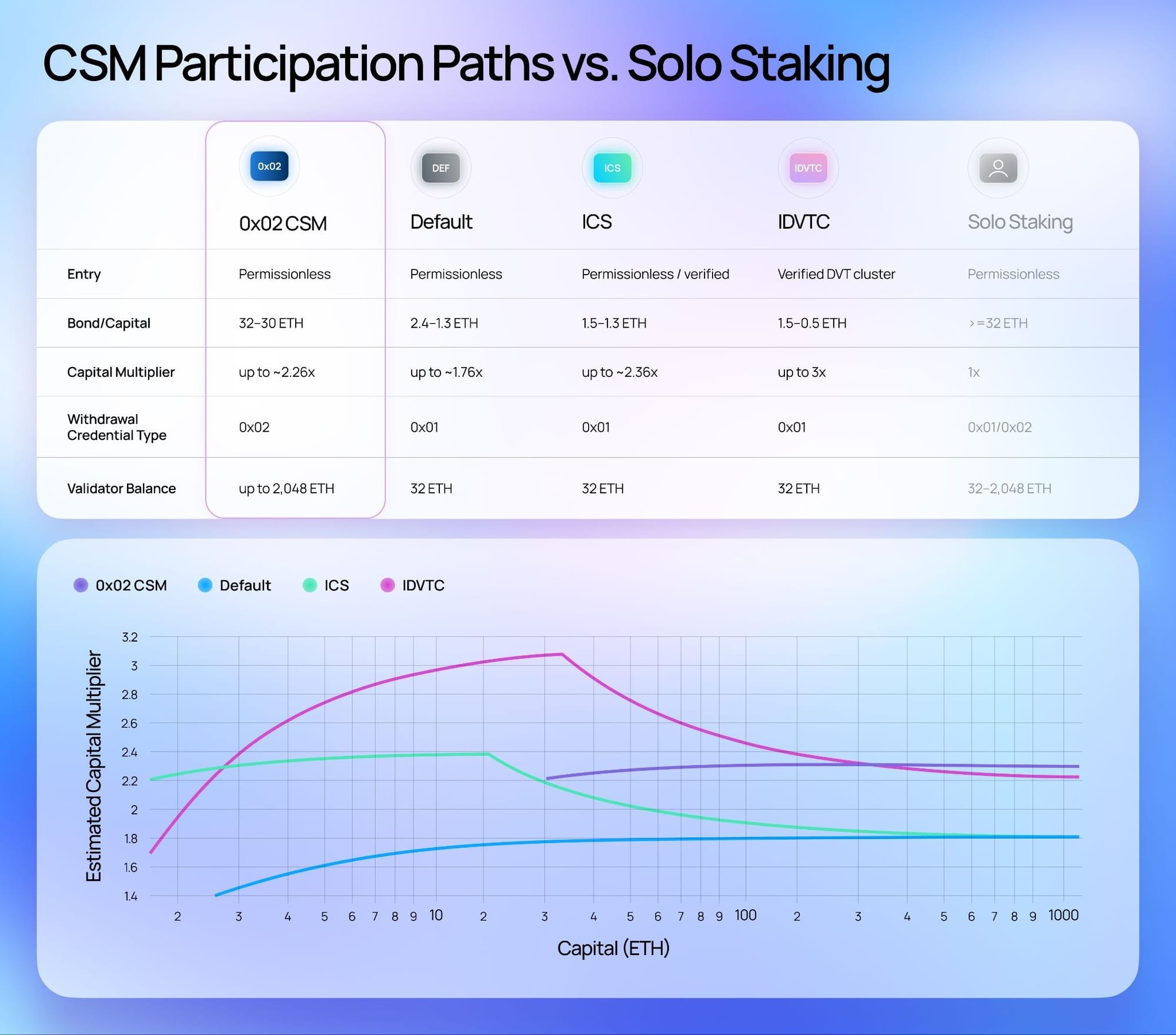
- Compared with solo staking, 0x02 CSM offers a potential capital multiplier of up to ~2.26x once validators reach an effective balance of 2,048 ETH, with bonds of 32 – 30 ETH per key.
- 0x02 CSM complements 0x01 CSM, expanding permissionless operator choice. Both modules remain available, and existing operators are not required to switch.
- Capacity will increase gradually, with an initial batch of ~32 validator keys receiving seed deposits followed by top-ups after activation.
What is 0x02 CSM?
As part of Lido’s broader effort to support the adoption of 0x02 withdrawal credentials, Lido has launched 0x02 CSM, a new permissionless instance of CSM built for validators using these credentials.
With this launch, anyone can run validators with a maximum effective balance of 2,048 ETH through CSM, opening another path for independent operators to participate in Ethereum validation at scale.
Lower entry barriers for higher-balance validators
As with 0x01 CSM, operators do not need to fund their validators themselves. Instead, they provide a bond, while the Lido protocol allocates stake to the validators. The bond requirements for 0x02 CSM are 32 ETH for the first validator key and 30 ETH for each subsequent key.
Including rewards from bond rebasing, the estimated capital multiplier at full effective balances starts at 2.18x for the first validator and approaches 2.26x as more validators are added, compared with solo staking.
Two queues: Seed first, top-up after activation
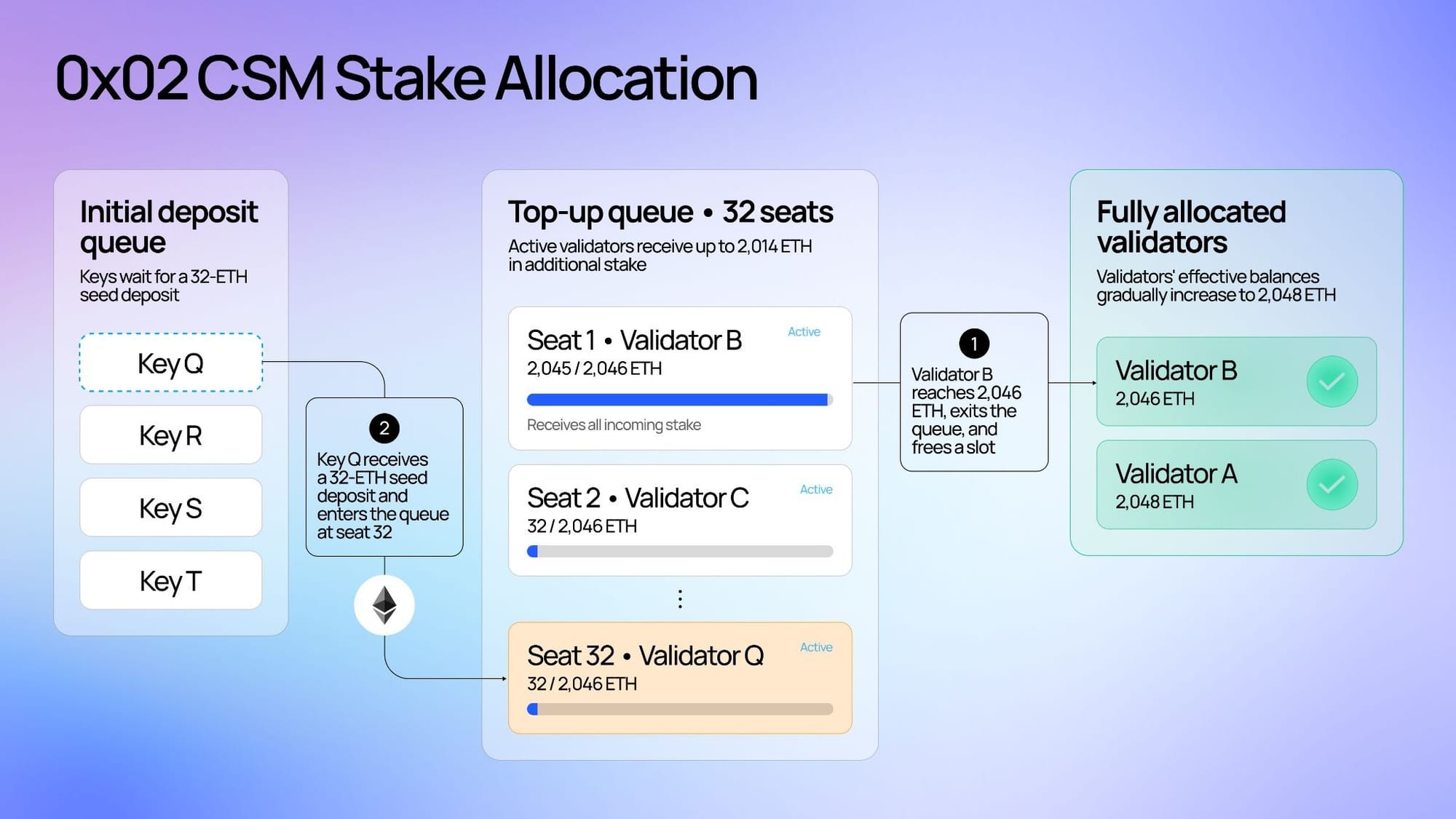
Unlike a 0x01 CSM validator key, which receives its full 32 ETH allocation in one deposit, a 0x02 CSM key receives stake in stages through a two-queue mechanism.
This balances onboarding new validators with increasing the balances of those already active. For operators, this means activation and full allocation happen in stages.
- Initial deposit queue. Submitted keys wait for an initial deposit of 32 ETH. This seed deposit allows a key to enter Ethereum’s deposit queue and await activation without waiting for its full stake allocation.
- Top-up queue. Once active, validators can receive additional stake, following the order established in the initial deposit queue. The top-up queue has a limited number of seats. When a validator reaches its top-up target, it leaves the queue and frees a seat for another key. Since seed deposits take priority, the next eligible key receives its initial 32 ETH before existing validators receive further top-ups.
A gradual rollout
0x02 CSM starts with a stake share limit of 0.01% of Lido Core TVL and a 32-seat top-up queue, with capacity increasing gradually.
The initial capacity is intended to seed ~32 keys. Once the first batch has received seed deposits and the validators have become active on Ethereum, the CSM Committee will propose a stake share limit increase through an Easy Track motion. This creates room to allocate additional stake to already-active validators waiting in the top-up queue, subject to sufficient protocol inflows.
As validators reach their top-up target, they free seats for new seed deposits. The process continues until the module reaches its stake share limit. Once enough newly seeded validators are active and ready for top-ups, the committee can propose another increase.
For more details, read the 0x02 CSM rollout plan.
0x01 and 0x02 CSM: What Operators Need to Know
With this launch, CSM expands from a single permissionless module into two complementary modules supporting 0x01 and 0x02 withdrawal credentials, respectively. Both modules run in parallel on the same CSM codebase. Furthermore, as approved by the Lido DAO, they share a maximum combined capacity of 20% of Lido Core TVL — representing an upper ceiling for future expansion rather than their current share limit.
One interface for both modules
In the CSM widget, 0x02 CSM appears as an option similar to operator types such as ICS or IDVTC in 0x01 CSM, although it runs as a separate module. Operators can manage their 0x02 CSM keys, bonds, and more alongside their existing 0x01 CSM profiles through the same interface.
No native migration from 0x01 to 0x02 CSM
There is no native consolidation-based migration from 0x01 to 0x02 CSM. An existing 0x01 CSM operator wishing to participate in 0x02 CSM would need to either operate in both modules or exit 0x01 CSM validators and use the released bond to fund new keys in 0x02 CSM.
Both CSM modules remain available, so existing operators can continue using 0x01 CSM without switching.
More ways to participate
CSM now offers four paths: 0x01 Default, 0x01 ICS, 0x01 IDVTC, and 0x02 CSM.
Operators can choose the path that suits their capital, eligibility, and preferred setup, or combine multiple paths where they meet the relevant requirements. ICS and IDVTC operators retain their preferential parameters in 0x01 CSM, but these benefits do not extend to 0x02 CSM.
The Future of CSM
There are no plans to deprecate 0x01 CSM in the near future. It remains the home of ICS and IDVTC and continues to offer a lower-bound entry point for operators. Alongside it, 0x02 CSM gives operators with more available capital a way to secure more stake through fewer, higher-balance validators.
Looking ahead: EIP-8148
EIP-8148 proposes setting custom balance thresholds for 0x02 validators, with funds above each threshold automatically swept to the corresponding withdrawal address. The EIP remains a draft, and its inclusion in a future Ethereum upgrade is not guaranteed.
If included in a future Ethereum upgrade, the EIP could allow CSM to support more flexible target balances for validators, such as 512 or 1,024 ETH. With further CSM development, this could broaden the available bond options and potentially remove the need for two separate modules.
Read the proposal and join the EIP-8148 discussion to share how custom sweep thresholds could support your staking setup.