Handling Redemptions on stVaults
Paying redemptions from staked ETH requires withdrawing ETH from validators, and the timing depends on Ethereum’s withdrawal process. New ETH allocations must pass through the entry queue before earning staking rewards; waits can also be lengthy, reaching 70+ days in the first half of 2026.
stVaults, Lido protocol’s modular staking infrastructure, allow redemptions to be covered through stETH liquidity, without waiting on the validator exit or entry queue.
Two questions shape how this works for a product. Whether the Vault Owner is permitted to hold stETH determines how a redemption is paid. Whether new ETH deposits are expected in time helps determine how the stVault’s resulting stETH Liability is cleared.
Step 1: Paying the Redemption
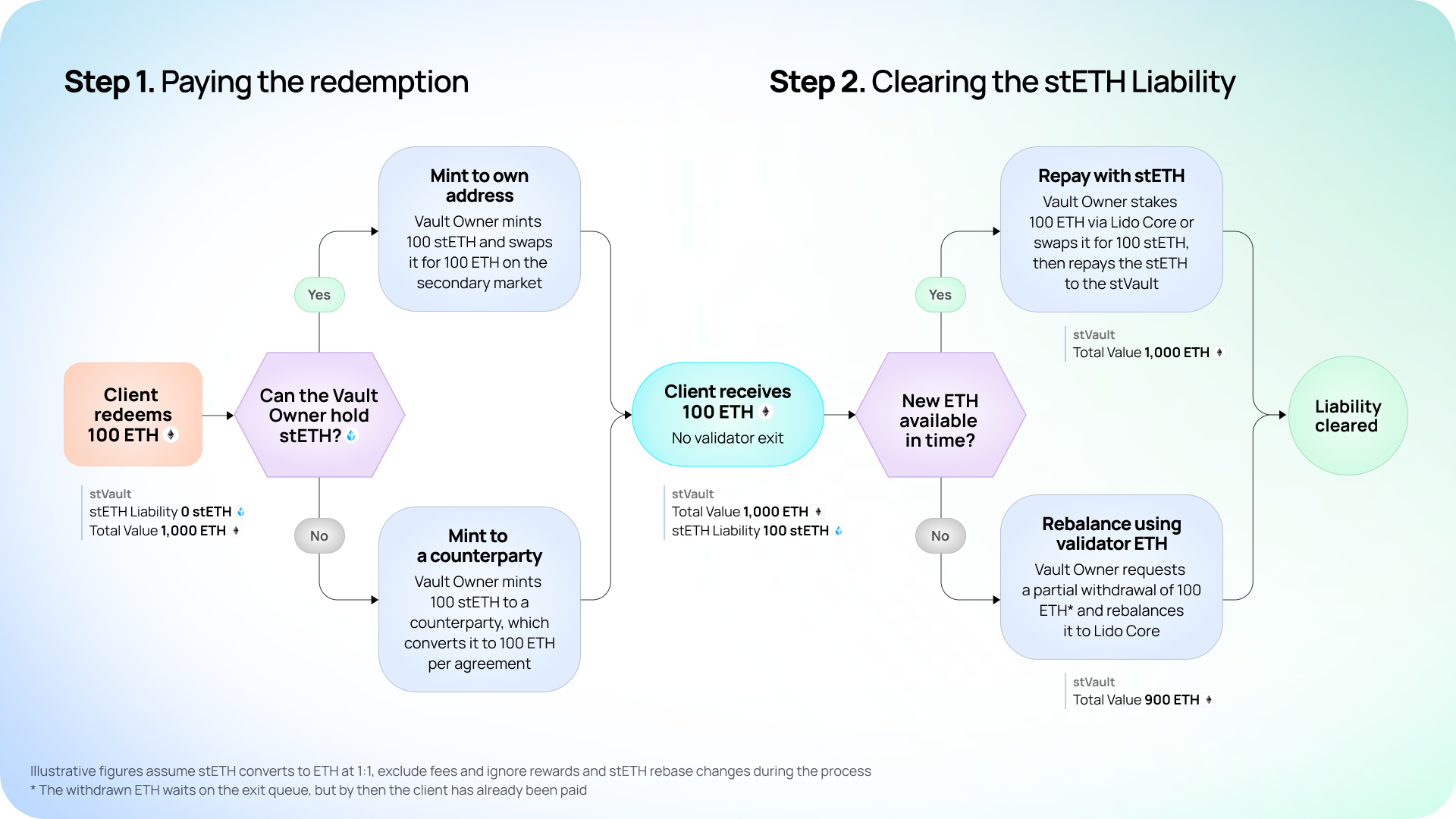
Covering a redemption via stETH liquidity starts with minting stETH and converting it into the asset in which the redemption is denominated.
The Vault Owner mints stETH in the stVaults Web UI, either to their own address or directly to a counterparty’s address, depending on whether the Vault Owner is permitted to hold stETH.
From that moment, the stVault carries a stETH Liability equal to the minted amount.
If the Vault Owner Can Hold stETH
The stETH is minted to the Vault Owner’s own address. The Vault Owner swaps it on the secondary market for ETH or for USDT/USDC, depending on what the redemption is denominated in, and sends the proceeds to the client.
If the Vault Owner Cannot Hold stETH
Where regulatory restrictions prevent the Vault Owner from holding stETH, it could be minted directly to a counterparty’s address, for example a market maker with a standing agreement. The counterparty converts it to ETH or to USDT/USDC per the agreement, and the proceeds are routed to the client. The stETH never touches the Vault Owner’s own balance sheet.
This route depends entirely on a prior commercial agreement with the counterparty, covering the mint recipient, swap terms and settlement timing. Lido has no visibility into or role in that agreement; it only sees the mint transaction and its recipient.
Either way, the redemption is paid out without exiting a validator.
Step 2: Clearing the stETH Liability
The stETH Liability created by covering a redemption can be cleared in two ways, and each fits a different situation.
Repay with stETH
With additional ETH deposit, the Vault Owner can stake it through Lido Core to receive stETH 1:1, or swap it for stETH on the secondary market, and repay that stETH to the stVault.
Repaying removes the stETH from circulation and reduces the stVault’s stETH Liability by the amount repaid. Repaying is also available in the stVaults Web UI.
Rebalance Using Validator ETH
When no new ETH deposits are expected in time, or the liability needs to be cleared as soon as possible (e.g., to reduce Lido liquidity fee paid on the amount of minted stETH or to close the stVault), the Vault Owner can rebalance. Rebalancing moves ETH from the stVault balance to Lido Core and writes off the same amount of stETH Liability 1:1, all in one transaction. Total Value goes down by the rebalanced amount, so the stVault has less ETH working.
Rebalancing uses ETH available on the stVault’s contract balance. If the balance falls short, the Vault Owner first requests a partial withdrawal from validators, which stVaults can do without a full validator exit. The withdrawn ETH waits on the exit queue, but by then the client has already been paid. Rebalancing and partial withdrawals are both available in the stVaults Web UI.
What This Looks Like in the stVault
For example, consider an stVault with 1,000 ETH staked, a 5% Reserve Ratio and no outstanding stETH Liability.
A client redeems 100 ETH. The Vault Owner mints 100 stETH to their own address or to an agreed counterparty’s address. The recipient converts it into 100 ETH, which is then paid to the client. The stVault’s Total Value remains 1,000 ETH, and its stETH Liability is now 100 stETH.
From there, the two ways of clearing the liability diverge:
Both clear the 100 stETH Liability created by the redemption. Repayment leaves more ETH in the stVault because the 100 stETH used to clear the liability is supplied separately.
Illustrative figures assume stETH converts to ETH at 1:1, exclude fees and ignore rewards and stETH rebase changes during the process. In practice, the amount required to clear the liability reflects its value at execution.
Known Constraints
- Minting is only possible within the stVault’s stETH minting capacity, which depends on its Total Value and Reserve Ratio. New minting uses available capacity, while repayment or rebalancing restores it. Rebalancing also reduces the stVault’s Total Value, so it restores less capacity than repayment of the same amount.
- The stETH Liability grows daily with the stETH rebase while it is outstanding, so a figure calculated yesterday will be slightly short today.
Further Reading
- Covering Redemptions with stETH Liquidity
- Multi-User Staking Product with Redemptions through stETH
- Rebalance stVault
- Control Validators and Withdraw ETH from the Beacon Chain
- stVaults Metrics
- Roles and Permissions
Want to talk through stVaults for your vault, your product, or your roadmap? Get in touch